Wednesday, January 25, 2006


Increased IRS Scrutiny of Family Limited Partnerships

The WSJ reports ($ubscription required) that:
The IRS is intensifying its scrutiny of family limited partnerships, a popular technique for reducing estate and gift taxes.

The heightened scrutiny comes as the Internal Revenue Service has stepped up enforcement more broadly, increasing the number of audits it performs. The agency has said it plans to focus more resources investigating taxpayers with incomes of $100,000 and above. Officials also are focusing especially on what they call abusive shelters, or transactions with no real economic purpose other than evading taxes.

As part of its deepening probe into family limited partnerships, the IRS is questioning more of these transactions and taking a harder line during audits, seeking evidence of whether they really were set up for legitimate business purposes -- or merely as an elaborate tax dodge, officials say. In an increasing number of cases, auditors are interviewing taxpayers' adult children and others involved in a partnership for details on how it was set up and run. Officials are sometimes even scrutinizing partners' medical records, or interviewing doctors, to determine if a partnership was improperly created mainly to save taxes by someone on the verge of dying.
The article suggests various ways in which FLPs can be structured to withstand scrutiny. However, at their core these methods all have characteristics that taxpayers forming FLPs often don't want, namely an entity that has an independent business purpose and that is more than an "incorporated pocketbook" for the senior member or members of the family. Once again, the most basic rule of tax law is that "pigs get fat, but hogs get slaughtered."

Hat Tip to The Law Blog.

Monday, January 23, 2006


Six of One, Half-Dozen of the Other

The recent case of Comptroller v. Blanton illustrates ways in which statutes, merely by the manner in which they are drafted, can be applied in essentially inconsistent ways. It's first necessary to have some background concerning the Maryland income tax.

Not many years ago, the Maryland income tax was pretty much a straight 5% levy. At that time, the various counties had the ability to enact "piggy-back" income taxes of up to one-half of the Maryland income tax. The county taxes were collected by the state and remitted to the appropriate counties. Subsequently, the maximum Maryland tax rate was reduced to 4.75% and the counties were allowed to set their own rates up to an additional 3.2%.

Because other states impose income taxes on income earned within their borders, there is a provision that allows a credit to Maryland residents with respect to taxes imposed by other states on non-Maryland source income. The issue in Blanton was whether this credit was applicable only to the Maryland tax or whether it applied to any county piggy-back taxes as well. The Court of Appeals held that the tax credit applied only to the Maryland income tax. Thus, Maryland residents are subject to a maximum income tax at the combined rate of (i) the higher of either the state income tax in the state in which the income is earned and (ii) the Maryland piggy-back tax.

The result can be illustrated by assuming that a Maryland resident has income from a source in another state that is taxed by that other state at a 7.5% rate. That individual will be able to offset against his or her Maryland tax an amount equal to 4.75% of the income derived from the other state. However, because the non-Maryland tax cannot be offset against the county piggy-back tax, in many cases, the total tax rate can be 10.7%, higher than the rate imposed by either state.

However, the result with respect to Maryland income of non-Maryland residents is quite different. The Maryland income tax applies to all Maryland income of non-residents and to all income of residents. However, the county piggy-back taxes apply only to the income of the residents of the respective counties. Thus, if a non-resident has Maryland income, he or she only pays the Maryland tax, not a county piggy-back tax. In most cases, the non-Maryland resident will be allowed a credit in his or her home state in an amount equal to the Maryland tax paid. While if the domicile of the taxpayer is Florida or one of the other states without personal income tax, the maximum tax imposed on the income is 4.75%, the virtually every other case the maximum rate of tax will not exceed the greater of the maximum Maryland tax rate or the maximum tax rate imposed in the taxpayer's state of domicile.

The manner in which the statute and the credit provision is structured results in Maryland residents being potentially subjected to higher rates of tax from income earned in other states, while residents of those other states pay a lower rate of taxes on Maryland source income. In fact, in some cases (e.g., where the taxpayer is a resident of Florida), the tax rate will be substantially lower on Maryland income earned by non-Maryland residents than on Maryland residents.

The decision in Blanton, as a matter of statutory construction, is clearly correct. However, it leads to a result that puts Maryland residents at a disadvantage. The irony is that the tax scheme does not need to lead to an anomalous result. There's an easy fix.

All that is necessary is for the Maryland tax to be restructured to provide that the tax rate is 7.95%. Each county could be allowed to enact a piggy-back tax of up to 3.2%. The county tax would be a credit against the state tax. Non-Maryland residents who have Maryland income would pay a tax of 7.95% on their Maryland source income, since they would pay no county tax, they would not be able to use the "county tax credit." Maryland residents would pay tax at the rate of no more than the 7.95%, which is either what most are either paying now or close to it.

On the other hand, Maryland residents would be allowed a credit against their Maryland tax of up to 7.95% of the tax paid to another state. Thus, the tax on non-Maryland income of Maryland residents would never be more than the greater of (i) the Maryland tax rate or (ii) the tax rate in the state where the income is earned.

Let me summarize: By changing the manner in which the statute is drafted, no Maryland voter would pay more tax on his or her income and many would pay less. The loss occassioned by the reduction in taxes on Maryland income would be offset by an increase in taxes on non-Maryland residents. In many, if not most, cases, this tax increase would not be borne by the non-Maryland resident, but by their home states.

What's not to like?

Sunday, January 22, 2006


If You Got A Warrant, I Guess You're Gonna Come In

Bob Ambrogi reports that:
News this week that the Justice Department is asking a federal court to compel Google to turn over records of millions of its users' search queries is shocking and disturbing. Worse yet, America Online, Yahoo and MSN have already complied with the subpoena.

For anyone who would rather not leave behind a trail of their search queries for government investigators to examine, there is a way to search Google and Yahoo anonymously -- it is called Scroogle. Its search proxy sends your queries through Google and returns the results free of ads and cookies, circumventing Google's tracking.

To learn more about Google and privacy, visit Scroogle's companion site, Google Watch.
I first went to Scroogle and learned that it allowed both Google and Yahoo searches without any tracking record. Interestingly, the site also recommended Clusty, which it states "has better results than Google and doesn't track you." Both Scroogle and Clusty have search icons that can be added to the Firefox search bar.

I then when to Google Watch. That site made statements about GMail which, if true, are also troubling:
Google offers more storage for your email than other Internet service providers that we know about. The powerful searching encourages account holders to never delete anything. It takes three clicks to put a message into the trash, and more effort to delete this message. It's much easier to "archive" the message, or just leave it in the inbox and let the powerful searching keep track of it. Google admits that even deleted messages will remain on their system, and may also be accessible internally at Google, for an indefinite period of time. For a few months they showed a note saying that messages left in the trash folder for 30 days would be automatically deleted, but many users reported that this never happened. Now that message, which is still present for the spam folder, is gone from the trash folder. Google wants very much to get to know you better.
* * * * *
After 180 days in the U.S., email messages lose their status as a protected communication under the Electronic Communications Privacy Act, and become just another database record. This means that a subpoena instead of a warrant is all that's needed to force Google to produce a copy. Other countries may even lack this basic protection, and Google's databases are distributed all over the world. Since the Patriot Act was passed, it's unclear whether this ECPA protection is worth much anymore in the U.S., or whether it even applies to email that originates from non-citizens in other countries.
I don't know whether this is true, but, as a protective matter, I fully intend to not to keep anything on my GMail account for more than 180 days.

Saturday, January 21, 2006


The Spies Who Love Me

The Federation of American Scientists has published on its website the National Security Agency's Redacting with Confidence: How to Safely Publish Sanitized Reports Converted From Word to PDF. I suspect that the practices set forth in the report can be applied to WordPerfect documents as well. Now there's no excuse for sending out pdf documents with metadata.

It is questionable whether it is unethical to read the other parties' metadata when a document has been sent to you by the opposing side. However, the sender should consider the malpractice implications of failing to sanitize documents.

Hat Tip to Boing Boing.


Information Overload?

At what point does the government have too much personal information? Even if it has a legitimate use for the personal information, does the danger of allowing government officials to have the information at their fingertips outweigh these legitimate benefits? These questions are raised by the following story from Tax Analysts:
IRS Fleshes Out Data Warehouse Plans; Outsiders Raise Concerns

In a January 20 phone interview with Tax Analysts, IRS Electronic Tax Administration Director Bert DuMars dismissed privacy concerns while laying out the details of a potential IRS data warehouse.

DuMars told Tax Analysts that the IRS has already begun studying the costs and benefits associated with creating a central database. It would house taxpayer information from Form W-2 as well as the "families" of Forms 1098 and 1099. The "data warehouse" would serve as a single collection point for the forms and would be made available to other government entities such as the Social Security Administration and state agencies.

"We’re not the only ones who need this information," he said.

DuMars told Tax Analysts that a data warehouse would not tread on any section 6103 disclosure rules because it would be shared only with entities that already have access to the data.

"I don't see a problem with [disclosure]," he said. "That’s not what we're concerned about here."

DuMars said at least two benefits could result from creating a database. Putting all the information in one central place would save time and money for the IRS and other agencies by replacing myriad separate and convoluted information-sharing processes. It would also make the information readily available to taxpayers. According to DuMars, if the data warehouse had been in place when Hurricane Katrina hit, thousands of taxpayers who lost documents would now be able to retrieve their information.

Several former tax administrators contacted by Tax Analysts raised concerns about the prospect of an IRS data warehouse, arguing that it could put the IRS on a slippery slope.

"The more convenient the information is, the more risk there is of losing it -- because you make it available to more people," said former IRS Commissioner Sheldon Cohen.

Cohen and others said that while a database might start with a limited number of forms, it's a short leap from there to adding more documents and information.
Over time, like most Americans, I've gotten used to having information that used to be private or semi-private open to ready public inspection. That is, there was a great deal of material (e.g., the valuation of your home for property tax purposes, court records, etc.) that was always open to public inspection, but it used to take some degree of energy to seek out the information. Today, however, that information is frequently only a mouse click away.

The principle invoked by the IRS here is that the proposal does not increase the number of people or agencies that have access to the information. Instead, the database would simply make it easier for those who are already authorized to view the data to access it. The reason that the proposal is troubling is that the obvious increased efficiency in the ability to access the data can be used for ill as well as good.

The story is also covered by the Center for Tax Studies weblog, here.

Friday, January 20, 2006


Don't Take My Wife, Please?

With apologies to the late Henny Youngman, there is this article from the New York Post via the California Estate and Business Law Blog:
Couples who stay married through thick and thin accumulate twice as much personal wealth as people who get divorced or remain single, a new study reveals.

In fact, divorce reduces a person's wealth by about three-quarters, compared to that of someone who never marries. And people who decide to split up even start seeing their finances erode years before the divorce is finalized.

"Getting married and staying married is a wonderful way to increase your wealth — but the key is stay married," research scientist Jay Zagorsky of Ohio State University told the Post.
Getting married and staying married may be positively correlated to increasing wealth, but it may not necessarily be a "wonderful way." As the aforementioned Mr. Youngman once said: "I've been married for 49 years. Where have I failed?"

Wednesday, January 18, 2006


Grover Norquist and the Tax Code

In October, I asked: Did Grover Norquist Commit Tax Fraud? The information that is publicly available is still too limited to allow one to definitively answer that question. However, the facts that are publicly available point to systematic violations by Norquist of various provisions of the Internal Revenue Code.

Case in point. In an article entitled The Pimping of the President, the Texas Observer gives a detailed account of how Jack Abramoff and Norquist got paid by two Native American tribes to provide a personal audience with President Bush. There seems to be some question as to who was in attendance, but there is no question that Norquist's organization, Americans for Tax Reform, recieved a $25,000 payment for Norquist's efforts. (A facsimile of the check accompanies the article.)

In my October posting, I noted that there are two entities controlled by Norquist that go by the name "Americans for Tax Reform." One is a 501(c)(3) charitable foundation, the other a 501(c)(4) "civic organization." The principal difference between the two classifications for the purposes of my October discussion was the fact that more stringent limits are imposed on the amount of lobbying expenses that the 501(c)(3) foundation can incur. However, there is an important limitation that applies to both types of entity. Specifically, neither a 501(c)(3) or a 501(c)(4) entity can be what is termed "an ACTION organization," although that term of art applies more broadly (and is thus more restrictive) with respect to 501(c)(3) entities than 501(c)(4) entities.

With respect to 501(c)(3) organizations, there are three forbidden areas:
  • Legislative lobbying efforts;

  • Participation in campaigns for public office; and

  • As described in Treas. Reg. Section 1.501(c)(3)-1(c)(3)(iv):
[The organization's] main or primary objective or objectives (as distinguished from its incidental or secondary objectives) [cannot] be attained only by legislation or a defeat of proposed legislation; and (b) [and it cannot] advocate[], or campaign[] for, the attainment of such main or primary objective or objectives as distinguished from engaging in nonpartisan analysis, study, or research and making the results thereof available to the public. In determining whether an organization has such characteristics, all the surrounding facts and circumstances, including the articles and all activities of the organization, are to be considered.
A 501(c)(4) entity is only an ACTION organization subject to losing the benefits of Section 501 if it engages in active participation in campaigns for public office. I will, as lawyers are wont to say, assume, arguendo, that Norquist honored the distinctions between the types of activities that 501(c)(3) organizations are prohibited from engaging in and the more broader range of activities allowed to 501(c)(4) organizations. However, even allowing Norquist that assumption does not get him off the hook.

The reason is that neither 501(c)(3) nor 501(c)(4) organizations can be "organized or operated for profit." (The term is from 501(c)(4), but but 501(c)(3) organizations are subject to limitations that are similar, but even more limiting.) Norquist's actions as detailed in the Texas Observer story show that he was using Americans for Tax Reform, whether in its 501(c)(3) or 501(c)(4) incarnation, as his personal business vehicle.

By way of example, the visit to the White House took place in May of 2001. The check in consideration for Norquist's efforts was drawn in the next month. This raises two possibilities.

First, Americans for Tax Reform may have been engaged in a profit-making endeavor. If that was the case, there was a violation of the rules under Section 501(c).

Alternatively, the lobbying was a business activity that Norquist personally engaged in. If that was the case, Norquist would be deemed to have "constructively received" the $25,000 check. In that event, he should have reported the $25,000 payment as income on a Schedule C on his Form 1040 for the year. He would not have been able to claim a deduction for the transfer of the funds to Americans for Tax Reform, regardless of whether the entity that the funds found their way into was the 501(c)(3) or 501(c)(4) entity.

Let me reiterate: There are not yet sufficient facts on the public record to prove that Norquist engaged in tax fraud. However, it is difficult to believe that the actual transaction reported in the Texas Observer was an isolated incident. Rather, it appears that Norquist, and probably others, used 501(c)(3) and 501(c)(4) entities to engage in the "business" of partisan politics. That business made them money, as their influence and the funding of their controlled 501(c) entities grew.

To determine whether a violation of the 501(c) rules occurred, the transactions engaged in cannot be viewed in isolation. Rather, "all the surrounding facts and circumstances, including . . . all activities of the organization, are to be considered." I assume that this is an effort that the federal prosecutors are currently undertaking.

Hat Tip: Mark Kleiman at The Reality-Based Community.


Damn It Jim, I'm A Tax Lawyer Not An Actor

It has been reported that William Shatner has sold a kidney stone to an on-line gambling casino, GoldenPalace.com, for $25,000, with the proceeds to go to a charity, Habitat for Humanity. Of course, the question that immediately comes to everyone's mind (?) is "What are the tax implications?"

Presumably, Shatner either deeded the actual stone to the charity or entered into an agreement with the casino that it would sell the stone and pay all proceeds to the charity. Thus, Shatner will not take any amount of the proceeds into income.

Arguably, he may be entitled to a small charitable tax deduction for the stone. The net amount of any charitable deduction for "self-created" property (I think we all can agree that the stone qualifies as "self-created") is measured by reducing the value of the item (i.e., $25,000) by the amount of ordinary income that the donor would have taken into account if he sold the valuable stone. One might think that this would mean that there is no charitable deduction since the entire amount that Shatner would have received if he had sold the stone would be subject to taxation at ordinary rates. However, this ignores the basis issue. If Shatner paid out of his own pocket for the medical care necessary to "produce" the stone, that amount would conceivably be deductible.

This, of course, is a detour. Tomorrow, back to real tax and business issues. In other words, all things must pass.

Sunday, January 15, 2006


How Smart Are We?

On the heels of the CRS study that shows that we cannot "save" ourselves out of budget deficits (my comments here), is a report, The Economic Costs of the Iraq War: An Appraisal Three Years After the Beginning of the Conflict, by Linda Bilmes and Joseph E. Stiglitz. That report serves only to emphasize the impossibility of regaining our budgetary and economic footing without raising additional taxes.

In the introduction, the authors note that:
Three years ago, as America was preparing to go to war in Iraq, there were few discussions of the likely costs. When Larry Lindsey, President Bush's economic adviser, suggested that they might reach $200 billion, there was a quick response from the White House: that number was a gross overestimation. Deputy Defense Secretary Paul Wolfowitz claimed that Iraq could "really finance its own reconstruction," apparently both underestimating what was required and the debt burden facing the country. Lindsey went on to say that "The successful prosecution of the war would be good for the economy."

Many aspects of the Iraq venture have turned out differently from what was purported before the war: there were no weapons of mass destruction, no clear link between Al Qaeda and Iraq, no imminent danger that would warrant a pre-emptive war. Whether Americans were greeted as liberators or not, there is evidence that that they are now viewed as occupiers. Stability has not been established. Clearly, the benefits of the War have been markedly different from those claimed.

So too for the costs. It now appears that Lindsey was indeed wrong—by grossly underestimating the costs. Congress has already appropriated approximately $357 billion for military operations, reconstruction, embassy costs, enhanced security at US bases and foreign aid programs in Iraq and Afghanistan. This total, which covers costs through the end of November 2005, includes $251bn for military operations in Iraq, $82bn for Afghanistan and $24bn for related foreign operations, such as reconstruction, embassy safety and base security. These costs have been rising throughout the war. Since FY 2003, the monthly average cost of operations has risen from $4.4bn to $7.1 bn – the costs of operations in Iraq have grown by nearly 20% since last year (whereas Afghanistan was 8% lower than last year). The Congressional Budget Office has now estimated that in their central, mid-range scenario, the Iraq war will cost over $266 billion more in the next decade, putting the direct costs of the war in the range of $500 billion.

These estimates, however, underestimate the War's true costs to America by a wide margin. In this paper, we attempt to provide a range of estimates for what those costs have been, and are likely to be. Even taking a conservative approach, we have been surprised at how large they are. We can state, with some degree of confidence, that they exceed a trillion dollars.
(Footnotes omitted, emphasis added.)

The report provides a valuable corrective to the truly abominable reporting by most mass news organizations of the economic issues surrounding the war. Thus:
The costs of the war in Iraq that have been reported in the media have almost exclusively focused on one type of cost – the $251bn in cash that the government has spent on combat operations since the invasion of Iraq in March 2003. This is an important element of the financial cost but it is only the tip of a very deep iceberg.

Currently the US is spending about $6bn per month on operations in Iraq. However, there are additional costs to the government – over and above this number. These include disability payments to veterans over the course of their lifetimes, the cost of replacing military equipment and munitions which are being consumed at a faster-than-normal rate, the cost of medical treatment for returning Iraqi war veterans, particularly the more than 7000 servicemen with brain, spinal, amputation and other serious injuries, and the cost of transporting returning troops back to their home bases. The Defense Department, for which expenditures not directly appropriated for Iraq have grown by more than 5% (CAGR) since the war began, has also spent a portion of this increase on support for the war in Iraq, including significantly higher recruitment costs, such as nearly doubling the number of recruiters, paying recruitment bonuses of up to $40,000 for new enlistees and paying special bonuses and other benefits, up to $150,000 for current troops that re-enlist. Another cost to the government is the interest on the money that it has borrowed to finance the war.

Although it is difficult to estimate these costs precisely, we can use current and expected troop deployment to make a reasonable projection of the likely costs. Looking purely at direct budgetary costs to the taxpayer, we estimate that the total cost of the Iraq war is in the range of $750 billion to $1.2 trillion, assuming that the US begins to withdraw troops in 2006 and maintains a diminishing presence in Iraq for the next five years. We have looked at the budgetary cost both including and excluding the cost of interest on the debt. We have also adjusted this cost for economic factors, as outlined in section two. Under any reasonable set of assumptions, the cost of the war even without considering the macroeconomic costs – is more than double the current number provided by the Administration.
(Emphasis in the original.)

In concluding, the report states that:
Though we have suggested that many of the costs were within the range of what could have been anticipated, we have not sought in this paper to ascertain whether on the basis of the information available, the Administration could have made more reliable estimates. We do not address the question of whether the disparity between the predicted numbers and the actual numbers is a result of a deliberate attempt of the Administration to mislead the American people on the cost of the war, or of incompetence, going to War with information of low reliability and with best estimates that were far from the mark. In response to accusations about the existence of weapons of mass destruction and the connection with Al Qaeda, the Administration has been adamant that it did not intentional deceive the American people; it prefers charges of incompetence to those of malevolence. We have not attempted to ascertain the relative role of each in the failure to provide the American people with an accurate cost of the venture. At the very least, though, honesty would have required laying out the various scenarios, even if it attached low probabilities to those that in fact turned out to be the case.

Americans could, and should have asked, are there ways of spending that money that would have enhanced our long run well being—and perhaps even our security—more. Take the conservative estimate of a trillion dollars. Half that sum would have put social security on a firm grounding for the next seventy-five years. If we spent even a small fraction of the remainder on education and research, it is likely our economy would be in a far stronger position. If some of the money spent on research were devoted to alternative energy technologies, or to providing further incentives for conservation, we would be less dependent on oil, and thereby more secure; and the lower prices of oil that would result would have obvious implications for the financing of some of the current threats to America’s security. While we may not know what causes terrorism, clearly the desperation and despair that comes from the poverty that is rife in so much of the Third world has the potential of providing a fertile feeding ground. For sums less than the direct expenditures on the war, we could have fulfilled our commitment to provide .7% of our GDP to help developing countries—money that could have made an enormous difference, for the better, to the well being of billions today living in poverty. We could have had a Marshall Plan for the Middle East, or the developing countries, that might actually have succeeded in winning the hearts and minds of those in the Middle East.

What is clear is that the Administration's original estimates were strikingly low. Would the American people have had a different attitude towards going to war had the known the total cost? Would they have thought that there might be better ways of advancing the cause of democracy or even protecting themselves against an attack, that would cost but a fraction of these amounts? In the end, we may have decided that a trillion dollars spent on the War in Iraq was better than all of these alternatives. But at least it would have been a more informed decision than the one that was made. And recognizing the risks, we might have conducted the War in a manner different from the way we did.
(Footnotes omitted.)

Recently, the "debate" over the war in Iraq, such as it is, has focused on only two aspects of the war.

The first is the "Were we lied to?" issue. That is, did the Bush Administration intentionally cook the information books in pushing for war.

The second aspect of the debate has been the "Well we're here now, how do we play the ball as it lies?" issue. That is, Administration supporters, on one side, paint those who want to terminate U.S. involvement quickly as defeatists who want to snatch defeat from the jaws of victory. Opponents of the war, on the other hand, sound the "We're waist deep in the Big Muddy and the Big Fool tells us to push on" theme.

To say the least, the debate has been less than edifying. I have long advocated the theory that the Internet, by putting an incalculable wealth of information at our fingertips, makes us smarter. However, my theory seems to be challenged by the reality that simple facts (e.g., the discretionary portions of the federal budget do not contribute to the budget deficit in a significant way) never seem to gain a foothold in the public discourse. Really complex questions (e.g., can we justify the costs of continuing the venture in Iraq when it weakens our ability to deal with foreign policy problems such as Iran and North Korea) seem hopelessly beyond our abilities.

Hat Tip: beSpacific.

Saturday, January 14, 2006


Due Process and Tax Sales

Tuesday, the Supreme Court will hear arguments in Jones v. Flowers, concerning the type of notice that is required to meet due process requirements in the case of tax sales of real property. The following summary is from the discusson of the case on the website of the Legal Information Institute of Cornell University:
In 1967 Gary Jones purchased a house in Little Rock, Arkansas. When he and his wife separated in 1993, his wife stayed in the house and he moved to a new address. Jones did not notify the tax authority of his new address. After both Joneses failed to pay taxes on the house, the Commissioner of State Lands sent a notice to Gary Jones' last known address via certified mail. The notice stated that the property would be subject to a public sale if Jones did not pay the delinquent taxes and penalties. The notice returned to the Commissioner as "unclaimed." Later, a newspaper announced the public sale of the Jones's house. Jones did not respond to the publication. When Linda Flowers offered to buy the property, the State again sent notice to Jones at his last known address via certified mail. This notice also was returned unclaimed. In 2003 Flowers bought the house. See Jones v. Flowers, No. 04-449, 2004 WL 2609800 (Ark. Nov. 18, 2004).

Jones then filed a complaint, claiming that the sale violated his rights under the due process clause of the Constitution because he never received actual notice of the tax sale or of his right to redeem. The trial court upheld the sale, finding that the State complied with due process by sending notices via certified mail to Jones’s last known address. See id.

The Arkansas Supreme Court affirmed the trial court's holding. The court cited Mullane v. Central Hanover Bank & Trust Co., 339 U.S. 306, 214 (1950), which held that due process does not require actual notice, and that notice is sufficient if it is "reasonably calculated, under all the circumstances, to apprise interested parties of the pendency of the action and afford them an opportunity to present their objections." Based on this standard, the court reasoned that the State was not required "to conduct a reasonable search of public records in an attempt to ascertain Mr. Jones's correct address before selling his property." The court found that the State only needed to send notice to Jones's last known address, which it did. See Jones v. Flowers, No. 04-449, 2004 WL 2609800 (Ark. Nov. 18, 2004). The court accordingly concluded that the sale was valid because Jones received adequate notice for due process purposes. See id.

The Supreme Court agreed to review the case to resolve the split among state and federal courts on the question of what steps the government must take to locate property owners before taking their property.
A more complete discussion of the case, including the policy implications and links to the briefs can be found at the LII link above.


Bureaucracy Is Everywhere

I've sometimes regretted that I did not become a comedy writer. Just think what I could do with the story in today's NYT that Jose Padilla had filled out an application to become a member of Al Qaeda. What information was requested?
  • Are you willing to become a martyr?

  • Do you have experience in small arms?

  • Do you know how to fly a jet airliner?

  • Any known allergies?

Friday, January 13, 2006


Notes On Federal Spending

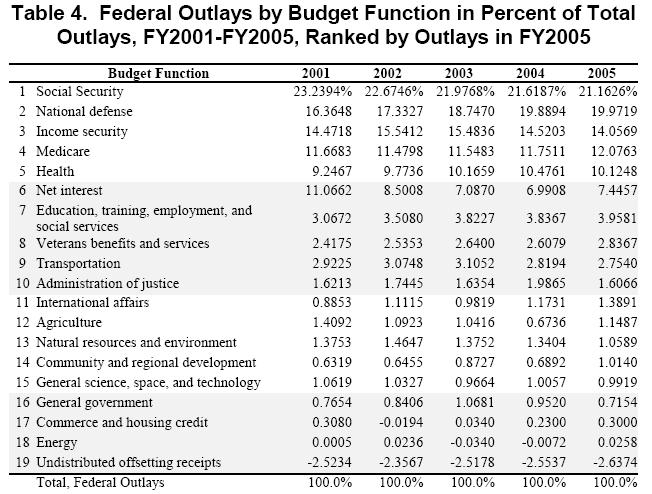
There's another good CRS report out, this time on federal spending. The report, Federal Spending by Agency and Budget Function, FY2001-FY2005, shows that non-military discretionary spending is fairly insignificant in the overall budgetary framework. Simply put, unless entitlements and the military budget are cut drastically, we cannot "save" ourselves out of the current budget deficit.

The top six budget functions, combined, accounted for 86.1% of federal expenditures in 2001 and 84.8% of federal expenditures in 2004. Five of the six (Social Security, Income Security (which includes unemployment compensation, food and nutritional assistance, and federal civilian and military retirement), interest on the federal debt, Medicare, and health benefits (which include Medicaid) are not discretionary. Moreover, as the report notes, "much less than the 30% to 40% of the budget considered discretionary can be reduced through appropriations alone" because:
Even the 30% to 40% of the budget that is subject to annual appropriations is not completely discretionary. Much of the annual appropriated amounts are necessary to fulfill legal commitments that the government had entered into in previous time periods, such as contracts or other obligations. Unless Congress and the President are willing to eliminate programs and the federal employees that run them, a certain amount of the annual appropriations are needed for federal salaries. In addition, approximately half of the annual appropriated amount goes to defense spending, which during a time of war is difficult to reduce.
The report has a table which shows federal outlays by budget function expressed as a percent of total outlays:

(Click to enlarge.)

Of course, there are winners and losers. Thus, there has been a dramatic increase in expenditures on the Executive Office of the President from $246 million to $7.725 billion. (For you math majors, that means that the amount of spending in 2005 was 31.4 times that for 2001.) Of course, there had to be some belt-tightening. The EPA, for instance, was held to an increase of only a little over 7% for the period covered, with spending actually falling from 2004 to 2005.

The summary of the report has it right:
Without a substantial reordering of the public's priorities as reflected in the government's allocation of resources, most spending reduction efforts seem destined to remain relatively small and, thus, are likely to have a limited effect on overall federal spending.
Hat tip to beSpacific.

Thursday, January 12, 2006


Wal-Mart Medical Insurance Bill ERISA Preemption Analysis

Paul M. Secunda of Workplace Prof Blog gives this analysis of whether ERISA preempts the Wal-Mart Medical Insurance Bill now before the Maryland General Assembly:
My first impression conclusion here is probably the same conclusion I came to [in an earlier post on bills pending in Massachusetts and Illinois which would require employers to foot the bill for employee health care through a "pay-or-play system."]: it all depends on whether Wal-Mart self-insures its health plans. If it does, the deemer clause should lead to ERISA preemption of the state law; if not (that is, it insures its health plans through another company), it should be saved from ERISA preemption as a law that regulates insurance under ERISA's Savings Clause.
As of this evening, one house of the General Assembly has overriden Gov. Ehrlich's veto of the bill and the override measure is moving to the other house.

Hat Tip to the WSJ's Law Blog.

Update

Whoops!! I should have checked the wire services before I finished my post. Even before I finished the post, the Maryland General Assembly overroad Gov. Ehrlich's veto of the Wal-Mart medical insurance tax bill.


Poetic Tax Law

Whoever said that tax law does not appeal to our higher faculties should read this by Jim Scheinkman:
To withhold, or not to withhold: that is the question:
Whether 'tis nobler in the mind to suffer
The slings and arrows of outrageous penalties,
Or to take arms against a sea of business situs tests,
And by opposing end them? To withhold: to report;
No more; and by tax reporting to say we end
The heart-ache and the thousand tax audits
That aggressive report positions is heir to, 'tis a consummation
Devoutly to be wish'd. To withhold, to report;
To remit: perchance to 1099: ay, there's the rub;
For in that reporting what dreams may come
When we have shuffled off all of our income,
Must give us pause: there's the respect
That makes calamity of so long statute of limitations;
For who would bear the whips and scorns of the IRS,
The tax agent's wrong, the taxpayer's form over substance,
The pangs of despised Treasury Regulations, the law's delay,
The insolence of the FTB and the spurns
That patient merit of the unworthy tax returns,
When he himself might his quietus make
With a bare bodkin? who would fardels bear,
To grunt and sweat under a weary tax code,
But that the dread of something after April 15,
The undiscover'd revenue ruling from whose bourn
No advisor returns, puzzles the analysis
And makes us rather bear those taxes we have
Than evade others that we know not of?
Thus Circular 230 Disclaimers does make cowards of us all;
And thus the native hue of income recognition
Is sicklied o'er with the pale cast of AMT,
And enterprises of great adjusted gross income
With this regard their cash flow turn awry,
And lose the name of after tax profit.--Soft you now!
The fair Ophelia! Nymph, in thy orisons
Be all my tax schemes remember'd.
I think I need a vacation.....
Hat tip to Bahar Schippel.

Wednesday, January 11, 2006


Do Not Go Quiet Into That Good Night

Monday, the NYT carried a story with this headline Lobbyist's Firm Escapes Fallout From a Scandal. The article tells the story of how Jack Abramoff's former law firm, Greenberg Traurig, proactively dealt with the potential client thefts by Abramoff.

The firm dismissed Abramoff in February, 2004, and commenced an internal investigation. As the report states:
Greenberg Traurig rushed to distance itself from Mr. Abramoff, appease his clients and work closely with prosecutors. In the process it has earned praise for its cooperation from Senator John McCain, Republican of Arizona, kept alive the possibility of suing Mr. Abramoff for its losses and negotiated financial settlements with most of Mr. Abramoff's victims.
However, the story also notes that "[a]fter its internal investigation, Greenberg Traurig quietly dismissed several people who had worked with Mr. Abramoff." The individuals who were dismissed were not identified, but presumably at least one or two are attorneys. This raises an interesting question.

Rule 8.3(a) of the Rules of Professional Conduct provides that:
A lawyer having knowledge that another lawyer has committed a violation of the Rules of Professional Conduct that raises a substantial question as to that lawyer's honesty, trustworthiness, or fitness as a lawyer in other respects shall inform the appropriate professional authority.
Based on the information disclosed in the NYT story, it seems that Greenberg Traurig adequately discharged its obligations under Rule 8.3(a) as to Abramoff since it apparently cooperated fully with the prosecutor. However, it is not so clear that the firm discharged its obligations under the rule with respect to any other attorneys involved.

The rule does not limit itself to cooperation with criminal prosecutors. There is a wide range of conduct that is not necessarily criminal, but which the rule requires to be reported. That's why the rule speaks of "appropriate professional authority," since it views the primary authorities to which reporting is to be made to be those organizations charged with enforcing the ethics rules in the District of Columbia and the various states. These organizations often sanction attorneys who run afoul of the Rules of Profession Conduct even when the acts or omissions do not constitute criminal violations.

Thus, there are some additional questions with respect to Greenberg Traurig's actions:

Were any of those who were "quietly dismissed" attorneys?

Did the conduct of any attorneys appear to violate the Rules of Professional Responsibility?

Finally, did the firm inform the "appropriate professional authority" of these possible violations?

Tuesday, January 10, 2006


The Chilean Pension System

For some time, conservatives have touted the Chilean pension system as a model to replace our current Social Security system. Several years ago, I looked at the details of the system and concluded that (i) it was primarily a way to fund investment in Chile, including the funding of public infrastructure and (ii) it would only work so long as Chile, an undeveloped country, was able to sustain high economic growth rates.

Apparently, the system is already breaking down. As reported in today's NYT, Chilean politicians are in agreement that the system doesn't work:
"There are two big issues, coverage and costs," Andrés Velasco, [the Socialist Michelle] Bachelet's economic adviser, said in an interview here. "Too many people are outside the system," he said, adding that too many of those in the system have found that "saving via the pension funds is quite expensive."
* * * * *
"Chile's social security system requires deep reforms in all sectors, because half of Chileans have no pension coverage, and of those who do, 40 percent are going to find it hard to reach the minimum level," [the conservative Sebastián] Piñera said in a televised debate with Ms. Bachelet on Wednesday. "This has to be confronted now, and we agree with Michelle Bachelet and will, I hope, join forces behind this large undertaking."
Most neutral observers are suddenly beginning to see the shortcomings of the system:
At the moment, the government pays about 5 percent of gross domestic product, or more than it spends for either health or education, on pensions for the poor, payments into a separate military retirement plan and so-called transition and administrative costs. Supporters of the privatized system argue that the state's burden will diminish as older retirees enrolled in the pay-as-you-go system that prevailed here before 1981 gradually die off.

But skeptics point to another developing problem: many young people, who should be enrolling in the system early to accrue maximum benefit, are staying out or paying in very little. Some cannot afford to contribute beyond the obligatory minimum payment, which is 10 percent of wages, while others are either self-employed or have been hired by companies as low-paid independent contract workers and therefore do not have to contribute at all.

"The bottom line is that this system does not work with this labor market," said Andras Uthoff, an economist who is director of the social development division of the United Nations Economic Commission for Latin America here. If trends continue, he added, "only a small percentage of people are going to be able to finance meaningful pensions. What happens then to the rest?"
I'm waiting for the knaves who support supporters of privatizaton of Social Security in this country to take notice.

Sunday, January 08, 2006


Looking for the CRS

Back in May, I complained that the Congressional Research Service reports did not have a single website "home" where one could use them as a research source. This past week, the CRS published a report entitled, Presidential Authority to Conduct Warrantless Electronic Surveillance to Gather Foreign Intelligence Information. Regardless of one's views on President Bush's warrantless electronic surveillance, one cannot argue that the public debate benefits by having access to a non-partisan, expert analysis of the legal issues. Yet, the CRS report, while not secret, cannot be found at any designated government website. By way of example, the above link to the report goes to the website of the Federal of American Scientists. (Hat Tip for the link to beSpacific.)

Obviously, given the great public interest in this particular issue, it is not terribly difficult to find a copy of the report. I suspect that it's available for download at dozens of locations. That is, of course, not necessarily the case with respect to all or even most CRS reports, some (many? most?) of which appeal only to policy wonks. Nevertheless, the time has come to put all of the reports on a single website with an adequate search engine to allow researchers to use the reports.


The Great State of Scam

Last September, I posted some comments about how a large number of California corporations were incorporating in Nevada to avoid California state taxes. Now there's this report in the Florida Asset Protection Blog about how Nevada corporate law is being touted as a vehicle to hide assets from creditors.

It seems that Nevada corporate law allows corporations to issue so-called "bearer" shares. That is, the legal owner of a share of stock at any given point in time is the individual who has physical possession of the stock certificate. The theory is that if your client gets wind of a creditor who might attempt to attach the stock, he just transfers physical possession of the stock to a willing dupe third-party confederate. Thus, if questioned, the transferor can truthfully deny that he owns the stock in question.

Jonathan Alper quickly shoots down this theory:
The problem is that the creditor protection of Nevada bearer shares works only if the creditor asks only if the debtor currently owns any corporate stock. In real life creditors can ask as many other questions as they want in an effort to locate assets subject to execution. For example, a creditor can ask if the debtor has owned any stock in the past years, and if so, what happened to the shares. A debtor must produce income tax returns. Tax returns include taxable income or losses from corporations and other investments. A creditor may ask about the current location and possession of any shares of stock which correspond to taxable income. A diligent creditor attorney will likely find out about any "bearer shares" a debtor owned previously and the current location of such shares. Giving possession of bearer shares to another person without fair consideration will likely be discovered and reversed as a fraudulent conveyance. I have never found any advantage for a Florida resident to establish corporations or LLCs in Nevada or any other state unless the Florida resident owns property or does business in the other state.
In Maryland, the scam would be even easier to demolish. All the creditor has to ask is whether the debtor owns legal or equitable title to any interest in any trust, business trust, partnership, limited liability company, or corporation. Notwithstanding the transfer of bare legal title to the individual possessing the physical stock certificate, it would seem clear that the transferor retains an equitable interest in the stock. Thus, the debtor has to either 'fess up to the ownership of the stock or perjure himself.

It seems to me that if you're willing to perjure yourself, you may as well use your home state's business entity statute. It generally has the advantage of being less expensive than Nevada.

The regularity that Nevada seems to pop up as a purported haven for the ethically challenged raises another issue: What the hell is the Nevada government up to?

It's one thing for some small Caribbean or Pacific island posing as a country to allow their business entity or trust laws to be used to scam U.S. creditors. After all, in the international arena, the law of the jungle more or less prevails. And, the countries that attempt to become tax or asset-protection havens at least have the excuse that they're basically broke and need to engage in quasi-legal activities in order to survive. However, the last time I looked, Nevada was one of the 50 states in the Union and a fairly economically successful one at that. Why has Nevada embarked on a directed and focused program to be the state of domestication for businesses that want to avoid compliance with the laws of the other 49 states?

Saturday, January 07, 2006


Small Town Newspaper Blues

This past week, veteran newspaper columnist Michael Olesker resigned from the Baltimore Sun due to plagarism allegations. A few comments.

First, the Sun's story can be found here. The AP's report, as carried by the Sun, can be found here. Both reports will disappear behind "for fee" firewall on or about the 18th.

Second, the precise instances of plagarism seem to me to be minor. By way of illustration, the following quote from the NYT:
But the disparity in incomes between the rich and poor grew after having fallen in 2002. Pay did not keep pace with inflation in the South, already the nation's poorest region, in cities, or among immigrants. And the wage gap between men and women widened for the first time in four years.
was tranformed into this in an Olesker column:
The disparity in incomes widened between the rich and the poor. Pay did not keep pace with inflation in the cities, among immigrants, or in the South, already the nation's poorest region. And the wage gap between men and women widened.
This is not exactly a case of a reporter stealing another reporter's scoop. In this case, and, I think, in all of the cases cited, Olesker only had to preface his comments with, "As [name of original reporter] in [name of original publication] has pointed out," to avoid a plagarism charge. I do that all of the time in this blog. However, I operate without two constraints that are imposed on columnists such as Olesker.

The first is that, for all practical purposes, I have no space limitations. My postings can be a long or short as I deem fit. There are no practical limitations imposed by financial considerations, since the marginal cost of each blog posting is zero. However, the size of a newspaper column is narrowly defined. It cannot be either too long or too short. I suspect that these limitations cause attribution to be omitted in some cases. (In fact, I don't even have to set forth the attribution of a quote or a fact in the text of a blog comment. A simple link to the original source is sufficient.)

The second is that newspapers and weblogs take a different approach to the lifting of quotes, etc. Newspapers view all of their work as proprietary. They are, after all, selling their work for a fee. If there is too much direct quotation, even with attribution, readership may decline. It is for this reason that the NYT has put all of its columnists behind a fee wall and virtually all newspapers put a fee wall in place some period of time after an article is initially published.

Bloggers, on the other hand, relish being picked up by other blogs. In general, after all, we're into this for the glory not the money. The benefits of blogs to their authors are directly proportional to the number of readers they have. Quotation of remarks or other sorts of attribution (e.g., Hat Tips) by other blogs tends to increase readership.

Third, the story was apparently initially triggered by the Baltimore City Paper, an "alternative" (read "free, but only weekly") newspaper. While I think that in this case the penalty was disproportinate to the journalistic infraction, I am glad that there was an alternative journalistic source that saw fit to investigate the issue. As local coverage via either print or traditional broadcast media (that is, TV and radio) declines, small markets in particular, such as Baltimore, will feel the loss. Local political and business interests will be able to take virtually any action, short of overt and obvious criminal action, without fearing public scrutiny. This is a very bad development.

Fourth, this is a Baltimore tragedy. Olesker has been a columnist in local papers for almost 30 years. He has a distinct "Baltimore" voice, having attended one of the city's premier public high schools (Baltimore City College), working on, what was then, a nationally-ranked school newspaper, The Collegian, then going on to the University of Maryland and working on its daily paper, The Diamondback. His columns more often than not focused on the people and institutions that make Baltimore, a small town masquerading as a city, unique. True local newspapers are disappearing. As they do, voices such as those of Olesker are disappearing with them. Olesker's resignation accelerates this unfortunate process.


Gentlemen Don't Read Each Other's Mail Department

PDF for Lawyers has an interesting posting about the Florida Bar Association's attempt to make the review of inadvertently communicated metadata in a document an ethics violation.

The posting had this precious quote from the initial article in the Florida Bar News:
"I have no doubt that anyone who receives a document and mines it . . . is unethical, unprofessional, and un-everything else," said board member Jake Schickel, who made the motion that the board express its disapproval at the practice.
Dave Fishel, who authored the posting, offered some expanded commentary in response to a reader's comments:
There are at least two different kinds of documents at issue here -- discovery documents and work product. I can't see ethical violations surrounding examination of metadata in discovery documents (and the courts are now regularly dealing with discovery metadata issues).

. . . . I don't think that a document filed with a court or specifically sent to opposing counsel for review should be afforded the same kind of protections that his briefcase and private papers get. That is, there is no "reasonable expectation of privacy" in filed or exchanged documents.

The Florida Board, however, makes no distinction between these doc types. The thing that is most disturbing to me is that this seems to be coming from the Board's profound ignorance of technology and lack of thought that went into their edict.
I think that Fishel has it right. I'm rapidly coming to the conclusion that bar association ethics committees, in general, have an almost institutional inability to deal with issues at the intersection of ethics and technology. (The decision making process here was not improved by the fact that, as Fishel indicates, the president-elect of the Board got burned by the Word track changes function.)


Been Down So Long It Looks Like Up To Me Department

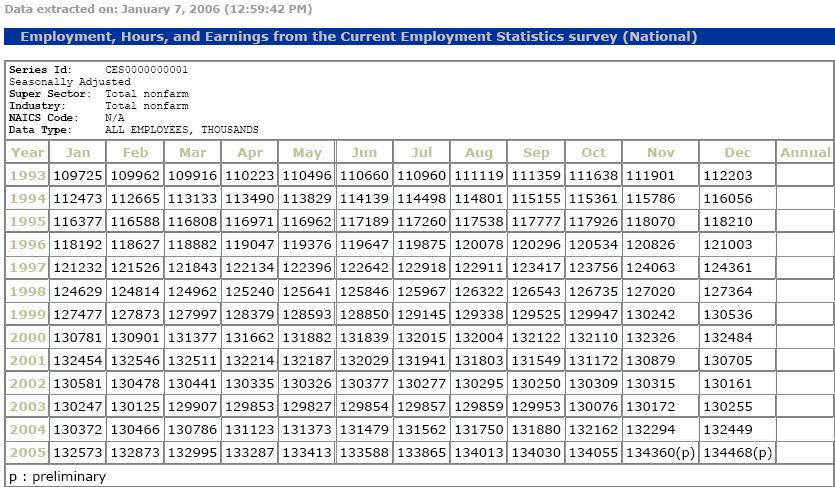
A friend who is, as they say on Curb Your Enthusiasm, a little (shake of the hand from side to side) conservative, with pride called my attention to this posting in Politpundit. It purports to show the great affirmative affect that the Bush tax cuts have had on employment growth. The stats cited are as follows:
Total Payroll Jobs

May 2000 - 131.9 million.
May 2001 - 132.2 million.
May 2002 - 130.3 million.
May 2003 - 129.8 million.
May 2004 - 131.4 million.
May 2005 - 133.4 million.
Dec 2005 - 134.5 million.
(May, 2003, emphasis in the orginal.)

My response? The figures are impressive---Not! The figures show just how bad the Bush Administration's stewardship has been.

On the chart, there are 31 months shown after May of 2003. In that period, the average monthly increase in jobs was over 151,000. What does this figure mean?

First, the economy needs to add somewhere between 135,000 and 150,000 jobs just to "stay even." That is, the total number of working Americans has to increase by that amount merely to keep up with a growing population. Thus, even in the limited period selected, job growth is merely treading water.

Second, it means that Bush comes in a distant second to Bill Clinton. During the 96 months of the Clinton Administration (measuring the statistics from March of 1993 to March of 2001), the country added, on average, over 235,000 jobs a month. That is, with a smaller population, Cinton did more than 55% better, on average, in each and every month of his administration than Bush did in the best partial slice of his administration.

Let's go one step further. Look at the best slice shown by the chart, May, 2004 to May, 2005. It shows job increases to average only 167,000 per month. (In the last 7 month slice shown, job grown falls to the low 150,000 average. Again, back to treading water.)

Of course, we could take the Bush Administration's performance as a whole, with a average monthly average increase in jobs of just over 38,000. But I doubt that PoliPundit wants to go there.

Here's a chart, created by the Bureau of Labor Statistics website, on the total number of non-farm payroll jobs from 1993 to 2005:

(Click image to enlarge.)

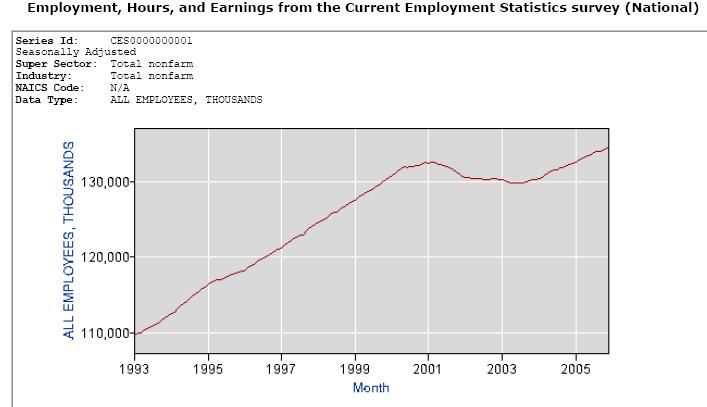
As a graph, the chart looks like this:


(Again, click image to enlarge.)

Analysing the statistics in another way, the total number of Americans working increased by over 20.5% during the Clinton Administration, an average 0.213% monthly increase. During the first 54 months of the Bush Administration, the increase has been a paltry 1.5%, or an average monthly 0.028% increase. Even looking at the limited time period that PoliPundit points to, the average monthly percentage increase is only 0.116%, or significantly less than the Clinton Administration's 96 month average percentage increase.

Update

Today (January 9, 2006), Kleinrock (subscription required) reported that:
Citing the 108,000 new jobs created last month as evidence that tax relief bolsters the economy, President Bush on January 6th blasted congressional Democrats during his speech before the Economic Club of Chicago for wanting to stop all tax cutting activity to stem the growth of the deficit.
Just one more time: If you create only 108,000 new jobs a month, the economy is losing ground. Daddy Bush and then Bill Clinton raised taxes. The result was the steep upward slant in the graph in the middle of this post.

(By the way, the consensus estimate with respect to the December new jobs figure was about 200,000. My guess is that the 108,000 reported by the BLS is actually low and that either January's number will be much higher or the revised December figure will shoot up, with the final result being that the average of the two months will hit at about the 200,000 estimate.)

Thursday, January 05, 2006


Plumber's Helper

In a case of clear national importance, the Circuit Court for Montgomery County ruled that the intentional exposure of a man's buttocks is not a crime in this state. The Washington Post has the story here. (Alternative headline: "Don't Swoon Over a Moon.") The defendant had displayed his posterior to a neighbor and her 8 year old daughter in the course of an argument.

The court felt that it could not make a distinction between an intentionally disrespectful about-face and more visually attractive exposures:
"If exposure of half of the buttock constituted indecent exposure, any woman wearing a thong at the beach at Ocean City would be guilty," Judge John W. Debelius III said after the bench trial, reversing the ruling of a District Court judge.
One of the defendant's attorneys remarked, that the "ruling should 'bring comfort to all beachgoers and plumbers' in the state."

Hat tip to Crablaw's Maryland Weekly, which not only picked up on the WaPo story first, but got a better headline ("Moon Over Maryland").

Monday, January 02, 2006


Don't Take My Word For It (Part II)

This morning the NYT had an article, Answering Back to the News Media, Using the Internet, that illustrates that I was not the first person to come up with the idea that fuller and more complete information should be posted on the Internet. However, the thrust of the story takes a somewhat different direction. Apparently, individuals and organizations who are the subjects of news stories are posting complete transcripts of interviews, including e-mail "interviews," in response to stories based on those interviews.

The spin of the Times article was that this trend was somewhat alarming:
Danny Schechter, executive editor of MediaChannel.org and a former producer at ABC News and CNN, said that while the active participation by so many readers was healthy for democracy and journalism, it had allowed partisanship to mask itself as media criticism and had given rise to a new level of vitriol.

"It's now O.K. to demonize the messenger," he said. "This has led to a very uncivil discourse in which it seems to be O.K. to shout down, discredit, delegitimize and denigrate the people who are reporting stories and to pick at their methodology and ascribe motives to them that are often unfair."

Thomas Kunkel, dean of the Philip Merrill College of Journalism at the University of Maryland, said reporting on reporters had created a kind of "Wild West atmosphere" in cyberspace.

With reporters conducting interviews more frequently by e-mail, he said, "You have to start thinking a couple of moves ahead because you're leaving a paper trail. And the truth squad mentality of some bloggers means you are apt to have your own questions thrown back at you."
My take is, of course, that more information is better. Rather than waiting for the subjects of stories to post transcripts and e-mail correspondence, the original story should contain links to notes, transcripts, and e-mail correspondence.

One of the criticisms of the practice of subjects posting source information on their weblogs is particularly unfounded. Specifically, the story notes that:
[T]he power of blogs is exponential; blog posts can be linked and replicated instantly across the Web, creating a snowball effect that often breaks through to the mainstream media. Moreover, blogs have a longer shelf life than most traditional news media articles. A newspaper reporter's original article is likely to disappear from the free Web site after a few days and become inaccessible unless purchased from the newspaper's archives, while the blogger's version of events remains available forever.
Who's fault is this? Newspapers, if they so desire, can simply keep articles readily available to readers for more than a week or two. Recently, WashingtonPost.com announced that it will allow articles to remain free on the site for 60 days before the articles go behind the subscribers-only wall. Previously, stories were only accessible for 14 days. (Hat tip to BeSpacific.)

With respect to the NYT, there is a RSS link generator for NYT stories. I used that link generator to create the link at the top of this posting to the story under discussion here. Thus, the link should be effective for more than the two weeks that would be the case if I had linked directly to NYT.com. However, with respect to most other papers, after two weeks a toll-wall pops up. This makes linking to smaller newspapers (is the Baltimore Sun listening?) particularly problematic.

For me, the bottom line is that I may want to read a distillation of various aspects of a news story via a news report. However, the distillation may whet my appetite for more information. In that case, the original report, via links, should act as a gateway to enable me to locate additional information.

Sunday, January 01, 2006


Don't Take My Word For It

One of the most amazing aspects of the Internet is the ability to access massive amounts of information rapidly and cheaply. Seen in this light, blogs represent an almost exponential increase in the number of "doors" available to gain access to information.

There is, of course, a related downside to this profusion of information. That is, with a great deal of "information" floating around, the "information" may simply be false. Thus, Wikipedia has recently had to grapple with anonymous postings that were factually incorrect and even defamatory.

Whenever possible, I attempt to provide links to cases or reports that I discuss. Thus, if I say that case of Smith v. Jones holds thus and such, I link to the opinion, making it easy for my readers to determine for themselves whether I got it right. Similarly, whenever possible, I try to link to academic and research reports that I discuss. Thus, it is bothersome to me that the reports of the Congressional Research Service are not routinely published on the web at one convenient location.

It is also troublesome that other web discussions, on blogs and other websites, often do not provide links to the source material that they discuss. A case in point is the report of the Center for Budget and Policy Priorities on the (non)effect of the Bush dividend tax cut noted in TaxProf. Paul Caron, editor of TaxProf, correctly linked to the CBPP report.

That report discusses a reseach report, How Did the 2003 Dividend Tax Cut Affect Stock Prices?, dated October 11, 2005, authored by Gene Amromin, Paul Harrison, and Steve Sharpe, who are on the staff of the Federal Reserve Board. There is no way, from the CBPP report, to immediately locate the Federal Reserve staff report to determine whether the CBPP got the story right.

I was able to locate a Federal Reserve report entitled How Did the 2003 Dividend Tax Cut Affect Stock Prices and Corporate Payout Policy? that seems to incorportate the report that the CBPP refers to, but adds to it a portion of another report. Thus, in addition to the authors noted by the CBPP, this report has an additional author, Nellie Liang. This report states that it is a "synthesis" of the report by Amromin, et al., and a report, Executive Financial Incentives and Payout Policy: Firm Responses to the 2003 Dividend Tax Cut, by Jeffrey Brown, Nellie Liang, and Scott Weisbenner. It is unclear what, if any, of the conclusions reached in either report were excised from the synthesis.

The "Stock Price" portion of the report concludes that the dividend tax cuts did not achieve their stated policy goal, namely raising stock prices of publicly traded stocks. (An increase in stock prices reduces the costs that publicly traded corporations have to pay for investment capital.) However, the second part of the report (the part on "Corporate Payout Policy") reaches an additional problematic conclusion. Specifically:
[The evidence suggests] that the effect of the tax cut on dividend policy was strongest at firms where the executive's personal financial gains were most positively affected by the tax cut.
In other words, executives of publicly traded companies acted rationally to maximize their financial interests, not those of their shareholders. ("What's good for General Bullmoose is good for the USA!")

The point is not that I distrust Paul Caron or the CBPP. I don't. To the contrary, unlike the editorial pages of the WSJ, which mislead as a matter of course and policy, I have found both TaxProf and the CBPP are "honest brokers," reporting the news as it is. However, there is a more important policy here. Whenever possible, reports and blog postings should link back to the root sources being discussed to allow readers to draw their own conclusions.

In this case, TaxProf was discussing the CBPP report, so it had no obligation to link back to the Federal Reserve research paper. It would have been nice if it had, but that would have involved a significant amount of time doing a web search and the TaxProf posting was limited to reporting on the issuance of the CBPP report. On the other hand, the CBPP should have undertaken the task of linking to the Federal Reserve report which, after all, was the focus of its paper.

Saturday, December 31, 2005


By The Numbers

The Statistical Abstract of the United States for 2006 is out. It's chock full of interesting stuff, such as this chart that shows that the American's median income, in constant dollars, fell between 2000 and 2003:

(Click to see a larger image.)

In other words, most Americans were economically worse off after the first two full years of Bush.

I've only started to plough through the wealth of numbers. I will comment on other statistics in the new year.

Hat tip to beSpacific.

Monday, December 26, 2005


The Rich Get Richer Department

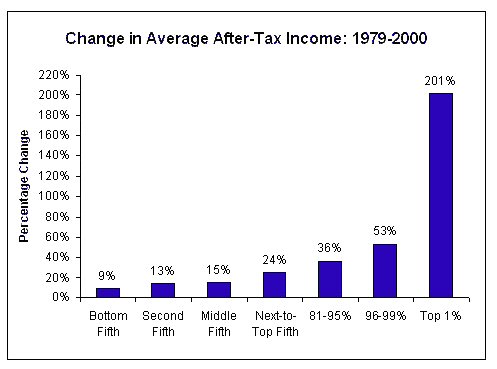
The Daily Kos has charts which illustrate the growing disparities of income in this country since 1979. The most striking is this one which shows that the top 1% of the population increased their income by an incredible 201% over the period. This is almost four times the increase that those in the top 4% achieved and about fifteen times the increase of those in the lower 60% of the population.


Just remember the charts the next time some knave attempts to fool you into believing that the rich are getting soaked.

Saturday, December 24, 2005


By The Numbers

The IRS just released the December Statistics of Income (SOI) Bulletin. Previously, I had posted comments concerning Treasury Secretary Snow's abuse of statistics that he claimed showed an increase in federal tax revenues since the passage of the 2003 Tax Act. The SOI indicates that, at least for 2003, Snow's assertion was false.

According to the SOI:
Taxable income, which is the result of [Adjusted Gross Income] less exemptions and deductions, rose 2.5 percent to $4.2 trillion. However, total income tax fell 6.1 percent to $748.0 billion for 2003. . . . The decline in total income tax for 2003 reflects the reduction in tax rates, under [the Jobs and Growth Tax Relief Reconciliation Act of 2003], which lowered marginal rates above the 15-percent rate bracket and expanded the width of the 10-percent regular tax rate bracket for all returns and the 15-percent bracket for joint returns.
(Emphasis added.) In other words, in 2003, income tax revenues fell due to the Bush tax cuts.

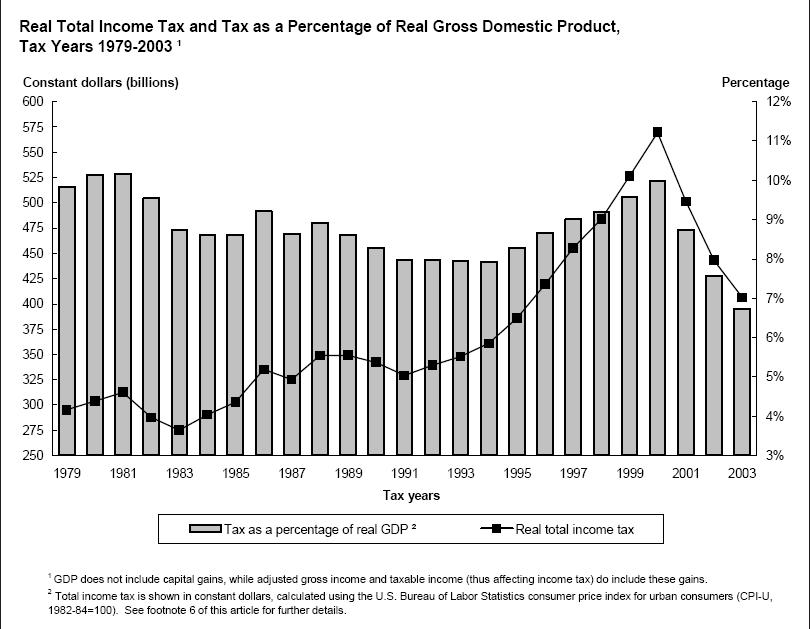
More startling is this chart which shows the decline in tax revenue as a percent of gross domestic product:


Admittedly, the SOI analysed 2003 revenue results while Snow pointed to revenue increases in 2004 and 2005. However, the 2004 and, particularly, the 2005 results are skewed by additional changes in the tax law that distort the picture by decreasing total revenue over time, but accelerating the receipt of the revenue.

Hat tip to Tax Analysts.


Is Mickey Kaus Nuts?

According to Mickey Kaus:
"Reasonable expectations of privacy," as the lawyers put it, are simply lower in the age of blogs and Webcams and surveillance videos than in the age of dial telephones. ... I wouldn't be all that upset if the Feds ran every damn phone call through the Echelon-style NSA computers. Do you have a problem with that?
Well, yes:
Any sound that Winston made, above the level of a very low whisper, would be picked up by it, moreover, so long as he remained within the field of vision which the metal plaque commanded, he could be seen as well as heard. There was of course no way of knowing whether you were being watched at any given moment. How often, or on what system, the Thought Police plugged in on any individual wire was guesswork. It was even conceivable that they watched everybody all the time. But at any rate they could plug in your wire whenever they wanted to. You had to live -- did live, from habit that became instinct -- in the assumption that every sound you made was overheard, and, except in darkness, every movement scrutinized.
1984 by George Orwell, Chapter 1.

Sunday, December 18, 2005


A Grain of Salt

On October 9, I commented on a story that was making the rounds of the blogosphere concerning a development project in Union Township, New Jersey. The meme of the various postings was that evil wealthy developers had, in essence, paid off a political boss in order to steal a valuable development opportunity from the proverbial little guy, one Carol Segal, and that this exposed the basic of the Supreme Court's opinion in Kelo. This particular story line was reflected by bloggers on both the left (Kevin Drum) and the right (The Queen of All Evil). I expressed my doubts that the actual facts were that simple ("As related by the anti-Kelo commentators, there is something of an air of a "just-so story" about this matter.")

At the time I posted my comments, I had missed the comments of Nathan Newman posted three days earlier. He had picked up some facts that I had missed, specifically that:
  • Segal, a local retired electrical engineer, [had bought] up a bunch of abandoned industrial property in Union Township for $1.5 million. He [lobbied] the local government to rezone the land for residential development, which will instantly make him rich, since what was low-value land becomes instantly more valuable with the zoning change.

  • The city [demanded] that as a condition of making Segal rich that he agree to various conditions, including working with developers picked by the Township, possibly for public interested reasons, more probably to share the economic booty from the zoning change with their political supporters.
Newman concluded that:
Let's be clear-- giving it to the original owner is not rewarding anything but dumb luck or shrewd political manipulation and lobbying prowess. And if we are rewarding the latter, then why complain if someone else with better political manipulation powers grabs the land?

Of course-- and this is the key point -- we should want no one gaining financially from manipulation of the political process. Which is why people need to FOCUS on the economic payoff from zoning changes and the public should demand that WHOEVER develops land after a zoning change has to pay the public for the windfall from the zoning change.
I'm not certain that I fully agree with Newman's political theory here, but the facts seem to support his view that this matter involves a sharp developer (Segal) who attempted to benefit from the same sort of exercise of police power that underlies the Kelo decision. The Township, for its part, simply wanted to exercise that police power differently.

I am in no position to determine whether that difference was totally benign (the development that the Township's preferred developers promised was more in line with the overall planning goals of the Township), partially benign (the Township's preferred developers simply offered the Township a a better economic return from the development), or outrageously malignant (the preferred developers got the deal due to a political payoff to a local political boss). But then neither are any of the other weblogs who commented on the story.

Last week, the Township canceled its plans to condemn the Schaefer Salt Site, as the Segal property is known. It gave as its reasons the costs of having to litigate the matter with Segal and the fact that it had too many other development irons in the fire. In another deal, for the development of a hotel, the Township had sold the land at a significantly reduced price and had given the developers large tax abatements. In response, Segal said "If the town gives us the same deal for the hotel, we'll give them $2 million -- five times what the town is selling it for -- and we'll take half of the tax abatement."

Of course, we now know the principle that Segal is attempting to vindicate. As the saying goes, now we're only dickering over the price.


Why Blogs Are Not Enough

In the past week, two news stories, one national, one local, illustrate why we need "institutional" news sources.

The national story is the NYT disclosure that President Bush ordered warrantless interceptions of communications to and from American citizens.

The local story is the report in the Baltimore Sun that Maryland environmental Secretary Kendl P. Philbrick faxed a letter to a powerful state senator arguing against a bill that the senator's committee was considering. Using the Maryland Public Information Act (the state analog to the federal Freedom of Information Act), the Sun obtained documents that reveal that Philbrick did not write the letter himself. Philbrick merely lifted the text, verbatim, from the text submitted to him in an e-mail by a lobbyist for the state's largest owner of power plants, Constellation Energy. The lobbyist was so comfortable with the relationship between himself and the Secretary that he suggested that Philbrick provide him with official letterhead and an electronic signature so that he could dispatch the letter himself. (Presumably, when questioned, the lobbyist will explain that he was merely attempting to save the state the cost of a stamp.)

Both the NYT and the Sun expended substantial amounts of time and money on their stories. It is unlikely that the stories could have been written by bloggers who are typically short on time and resources. The stories broke only because the two papers had deep enough financial pockets to fund the investment that their investigations required.

The reports also illustrate the importance of the Sun's lawsuit against the Ehrlich administration's attempt to restrict the access of certain reporters to government sources. (Discussed here and here.) Newspapers operate much like other businesses insofar as their profit margin is not the same for all of their activities. Mundane reporting is relatively cheap, investigatory reporting expensive. To some degree, the profit from the day-to-day reporting supports the more cost-intensive (and lower profit margin) investigative reporting.

If the Ehrlich administration is allowed to limit the access to government of reporters that it doesn't like, it will effectively be increasing the cost of reporting on mundane affairs. As a practical matter, this will limit the ability of newspapers to undertake serious investigatory reporting.

Friday, December 16, 2005


Ho, Ho, Ho!

From Representative John Dingell (D-MI) as reported on the weblog of the National Jewish Democratic Council:

'Twas the week before Christmas and all through the House,
no bills were passed 'bout which Fox News could grouse.
Tax cuts for the wealthy were passed with great cheer,
so vacations in St. Barts soon should be near.

Katrina kids were all nestled snug in motel beds,
while visions of school and home danced in their heads.
In Iraq, our soldiers need supplies and a plan,
and nuclear weapons are being built in Iran.

Gas prices shot up, consumer confidence fell.
Americans feared we were in a fast track to ..... well.
Wait, we need a distraction, something divisive and wily,
a fabrication straight from the mouth of O'Reilly.

We will pretend Christmas is under attack,
hold a vote to save it, then pat ourselves on the back.
Silent Night, First Noel, Away in the Manger,
Wake up Congress, they're in no danger.

This time of year, we see Christmas everywhere we go,
From churches to homes to schools and, yes, even Costco.
What we have is an attempt to divide and destroy
when this is the season to unite us with joy.

At Christmastime, we're taught to unite.
We don't need a made-up reason to fight.
So on O'Reilly, on Hannity, on Coulter and those right-wing blogs.
You should sit back and relax, have a few egg nogs.

'Tis the holiday season; enjoy it a pinch.
With all our real problems, do we really need another Grinch?
So to my friends and my colleagues, I say with delight,
a Merry Christmas to all, and to Bill O'Reilly, happy holidays.
Ho, ho, ho. Merry Christmas.

Hat Tip to Jonathan Zasloff of The Reality Based Community ("The War on Chanukah").

Wednesday, December 14, 2005


Snow Job

On December 8, TaxProf had a nifty chart courtesy of Secretary of the Treasury John Snow which showed the increase in federal tax revenues since the passage of the 2003 Tax Act. The chart shows that federal tax revenues in FY 2005 increased by a whopping $260 billion or so from revenues in FY 2004. Don't be deceived.

Today, TaxProf links to the AP story on the amount of funds coming back to this country due to the one-time tax cut on repatriated foreign earnings (Companies Mum on How They Will Spend Funds). Apparently, the amount of repatriated earnings will be in excess of $300 billion.

I previously blogged on this windfall. In essence, there is a one-time reduction of tax on repatriated earnings from 35% to 5.25%. Applying a little simple arithmetic, it would seem that about $16 billion of the $260 billion in increased FY 2005 revenue is directly related to this one time accounting gambit. Bunching this income into 2005 merely allows the true revenue picture to be distorted. And, of course, over time, the acceleration of revenue into FY 2005 causes a net diminution of revenue over time in the approximate amount of $90 billion.

Even though the repatriated funds cannot be distributed to shareholders directly in the form of dividends, cash is fungible. Thus, the repatriated funds are, to some extent, being distributed as dividends, albeit not directly. (As the AP story reports: '''The tawdry secret about (repatriation) is that it is not likely to change domestic spending,' said Kevin Hassett, director of economic policy studies for the American Enterprise Institute.") Increased distribution of dividends further increases revenues in FY 2005, but in the same distortive way. At best, this part of the increase in revenue represents only an acceleration of the realization of the revenues, not an overall increase in revenues. In fact, over time, the aggregate amount of revenues received is likely to be lower, not higher.

Yes, there are other reasons for the increase in revenue, most particularly the fact that the business cycle came around and the economy has moved out of the recession that it was in. None of these other reasons give credence to the Orwellian nonsense that Snow is peddling that the Bush tax cuts created revenues. But a significant part of the revenue "increase" is due simply to accounting hocus-pocus and is not an increase at all.

Tuesday, December 13, 2005


Gratuitous Sex

From ContractsProf Blog, proof that even staid law school types sometimes put gratuitous sex in their blog. The posting, Expensive Yacht Only "Incidental" to Oral Sex, is from a case decided in 1998, so it certainly isn't current. But the extensive use of quotations from the opinion is certain to draw search engine attention. ("Peters took a woman on a 'sex-filled sailing adventure' to Catalina Island." "Appellant is not claiming that his yacht plunged into a wave trough, causing him to stumble and fall, mouth open, onto Susan L.'s vagina." "There is no proof that appellant ever steadied Susan L. on the boat, and certainly not by grabbing her crotch.")

I would never resort to such sordid tactics to get this blog picked up by search engine bots.

Oh, wait a second. I just did.


Fiscal Meltdown Ahead

Via Tax Analysts:
GAO Chief Again Warns Tax Increases May Be Necessary

U.S. Comptroller General David Walker on December 12 opened a White House conference on aging with a warning that will be unwelcome to a president known for his tax-cutting ambitions: Raise taxes to avoid a fiscal meltdown.

"While nobody likes tax increases, including me . . . in the final analysis, over the longer term, you have to have enough revenues to pay your current bills and deliver on your current promises," he said.

According to Walker, the retirement of the baby-boom generation will put such a strain on the federal budget that tax increases will have to be part of the solution.

With a 15-year term as head of the Government Accountability Office, Walker enjoys a degree of insulation from repercussions for politically unpopular stances. In late October he called for allowing some of President Bush’s tax cuts to expire, and at the December 12 conference on aging he renewed a campaign against tax preferences that began with a stinging GAO report in September.

"Part of the problem is the way we keep score in Washington," Walker said. "Tax preferences are largely off the radar screen even though they amount to $700 to $800 billion a year in forgone revenue."
An audio/video feed of the conference can be found here. Walker's presentation begins at about 50 minutes into the feed. Walker's principal lesson "The past cannot be prologue." He notes that in the last 4 years, the unfunded liabilities of the federal government rose from $20 trillion (Yes, with a "t." According to Merriam-Webster "a very big number.") to $43 trillion. The unfunded debt is beginning to approximate the $48 trillion in total net worth of all Americans.
The status quo is not an option. . . . There is no way that we're going to grow our way out of this problem.
* * * * *
"While nobody likes tax increases . . . . In the final analysis, over the longer term, you have to have enough revenues to pay your current bills and deliver on your future policies."
Admittedly, the presentation appeals to policy wonks, but it is startling to see a mild-mannered, green eyeshade type get really angry.