I have deleted the Bloglet subscription box and terminated this weblog as a covered weblog under Bloglet. I imported all Bloglet subscribers, except those whose subscriptions were anonymous, into FeedBlitz.
My understanding is that Bloglet's performance was spotty at best and, in any event, does not deliver the postings with HTML format as does FeedBlitz.
Thursday, October 05, 2006


Wednesday, October 04, 2006
Will I Know It When I See It?
One would think that most fundamental questions in tax law were settled. For instance, when is an organization a partnership for tax purposes? Unfortunately, that is not always (or even often) the case.
Brad Borden of Washburn University School of Law will publish The Federal Definition of Tax Partnership in an upcoming issue of the Houston Law Review. The paper is now posted on SSRN. As Borden explains in the abstract:
Brad Borden of Washburn University School of Law will publish The Federal Definition of Tax Partnership in an upcoming issue of the Houston Law Review. The paper is now posted on SSRN. As Borden explains in the abstract:
[C]ourts, Treasury, and the IRS generally have not considered the purposes of partnership tax law in the more than 150 instances they have interpreted and applied the definition of tax partnership. As a result, those efforts have produced ten separate tests for defining tax partnership, perpetuating the definition's uncertainty. This Article identifies and evaluates each of those tests and recommends abandoning tests that do not incorporate the purposes of partnership tax law and consolidating the remaining tests. Based on that consolidation, the Article proposes a new definition of tax partnership. The proposed definition incorporates the purposes of partnership tax law, and, because partnership tax law was intended to govern substantive-law partnerships, it includes some aspects of the substantive-law definition. Nonetheless, by using tax-specific terminology and relying on the purposes of partnership tax law, the proposal clarifies the definition of tax partnership and moves away from the substantive-law definition.The simple definition:
A tax partnership is two or more persons, at least one of whom provides significant services, who have (or will have) common gross income.It probably comes as a great surprise to non-tax practitioners, but the question of whether an arrangement is or is not a partnership for tax purposes arises fairly often. While obviously borne in academe where Borden currently resides, the article provides useful guidance to work-a-day practitioners.
Tuesday, October 03, 2006
Blackwhite
From the WSJ:
From the Center on Budget and Policy Priorities, we find this graph which exposes the WSJ's editorial bull:

As with almost all Republican argument today, Orwell is the best reference:
Republicans also deserve credit for financing the war, which is more than many Democrats say they'll do if they run Capitol Hill. The extension for two more years, through 2010, of the 15% rate on dividends and capital gains will also help sustain the economic growth that is throwing off record revenues to pay for the war even as the budget deficit declines.Let me get this straight: The Republicans financed the Iraq War by failing to finance the Iraq War?
From the Center on Budget and Policy Priorities, we find this graph which exposes the WSJ's editorial bull:

As with almost all Republican argument today, Orwell is the best reference:
"The key-word here is blackwhite. Like so many Newspeak words, this word has two mutually contradictory meanings. Applied to an opponent, it means the habit of impudently claiming that black is white, in contradiction of the plain facts."Hat Tip: Brendan Nyhan.
Monday, October 02, 2006
Looking for a One-Arm Economist
A recent CRS report, Running Deficits: Positives and Pitfalls, makes two points about federal budgetary deficits. Maybe.
First, deficits paid by younger generational cohorts to finance benefits for older generations may be justified. Thus:
First, deficits paid by younger generational cohorts to finance benefits for older generations may be justified. Thus:
Some shifting of resources to older generations . . . can be justified on the basis of equity. To the extent that technological change leads to greater prosperity over time, future generations will have access to higher standards of living. To the extent that population growth increases the size of the economy, the burden of financing pay-as-you-go retirement systems is reduced. If some of those gains are shifted from younger to older generations, then incomes and levels of well-being would be more equal among generations. Furthermore, a fiscal policy that shifts some resources from younger to older generations can raise living standards of all following generations by transferring a portion of the benefits of future economic growth into the present.Or, perhaps not:
The possibility of raising standards of living by shifting resources from younger to older generations has its limits. The example above relies on the assumption that the policy continues indefinitely into the future. With a finite ending point this policy would be unsustainable because some young cohorts near that end point would be made worse off and would be unwilling to give up resources.On this point, the report's conclusion takes an "on the one hand, on the other hand" approach:
Despite the projected magnitude of these intergenerational transfers [Social Security and Medicare, particularly Part D], younger generations might not be worse off than their parents if economic grows at a sufficiently swift pace.However, when it comes to the question of permanent structural deficits, the report has only one arm:
These generational transfers are largely driven by the growth in the number of beneficiaries of entitlement programs relative to the work force, as well as by rapid increases in health care costs. The possibility that some future generation may eliminate fiscal policies that it perceives will lower its standard of living introduces political risk into social insurance programs funded by a pay-as-you-go mechanism. If a generation anticipates that a younger generation will stop contributing to a pay-as-you-go social insurance program, then it may decide to end the program itself. A generation whose descendants are unwilling to finance its benefits would have little to gain, apart from altruistic impulses, by continuing its contributions.
A government that runs deficits and is unwilling to raise taxes or cut spending faces three choices. First, domestic borrowing can be increased at the cost of crowding out domestic investment. Second, a government can borrow from foreign investors and governments. Borrowing from the rest of the world prevents deficits from crowding out investment. That is, foreign investors can provide financial resources now in exchange for future interest payments and profits. As foreign investors accumulate larger portfolios of stocks, bonds and other assets, the flow of interest payments, dividends and repatriated profits abroad increases as well. Third, a central government can print money to reduce the real value of debt denominated in domestic currency.(BTW, talk about samizdat. I had to call my Congressman's office for a copy of the report. It was faxed to me, which explains the poor reproduction quality. As soon as I get a better copy, I will scan it and replace the fax version.)
All three options have unpleasant consequences. Over time, each can seriously damage national economies. Simple supply and demand theory implies that a smaller supply of savings for private investment will lead to higher interest rates and lower growth in private capital stocks. Lower stocks of private capital threaten economic growth, and slower economic growth translates into lower average living standards in the future. Borrowing from the rest of the world permits higher levels of investment and faster growth at the cost of sending a higher fraction of earnings abroad. If foreigners lend capital by purchasing stocks and bonds rather than by building auto plants, for example, they may decide suddenly someday to take their investments elsewhere. This could strain domestic and international financial systems, thus constricting firms' and households' access to capital. Finally, inflation caused by printing money distorts the flow of information generated by the price system and disrupts financial markets. Investors, if they wish to avoid capital losses in real terms, demand higher interest rates when they see signs of inflation. A major reduction in the real value of the federal debt would require a significant acceleration in inflation. Few economists believe that the restrictive monetary policies needed to squeeze rapid inflation out of an economy would not require substantial economic disruption, at least in the short run.
On the other hand, reducing government deficits can improve economic performance in at least three ways. First, paying off government debt increases the supply of investment funds available for domestic investment. Second, paying off government debt held by foreign governments or investors reduces the amount of interest payments going abroad. Alternatively, paying off debt held by domestic investors gives them the opportunity to rebalance their portfolios by buying foreign assets, which offsets some of the flow of dividends and profits going abroad, or by buying domestic assets that otherwise would have been bought by foreign investors. Third, scaling down the federal debt decreases the temptation to reduce its real value by printing money, lessening the possibility of a major acceleration in inflation. Finally, most economists believe reducing government borrowing lowers interest rates, which in turn have positive effects on investment and growth.
Friday, September 29, 2006
Ungrateful Deadweights
The Tax Foundation takes, ah, dead aim at the issue of tax expenditures and is somewhat off target. That is, the criticism does score some points, but does not hit the bull's-eye.
The TF discussion was triggered by the appearance in public web access of a CRS report, Tax Expenditures: Trends and Critiques. (Why CRS reports remain a sort of public policy samizdat is beyond me. The report in question had actually been posted by TaxProf two weeks ago, but only this week became widely available via Open CRS. But that's a rant for another day.) Tax expenditures are "those revenue losses attributable to provisions of the Federal tax laws which allow a special exclusion, exemption, or deduction from gross income or which provide a special credit, a preferential rate of tax, or a deferral of tax liability."
A good deal of the Tax Foundation's criticism is well founded. For instance, the posting states that:
She concludes by saying that:
The first paragraph in the TF posting is completely correct. The second paragraph is not.
The first link that I have left in goes to a Wikipedia entry that merely defines and discusses the concept of "deadweight loss." The second link goes to a Wikipedia entry that discusses the "Economics of Taxing a Good." But, in dealing with the question of whether or not to increase or decrease income taxes it is simply wrong to assume that all taxes create the same deadweight effect. Brad DeLong addressed this issue in January, 2005:
Finally, an examination of two charts in the CRS report are particularly revealing with respect to who benefits from tax expenditures, a point that the TF ignores. Chart 4, below, shows various various tax expenditures and, for each, shows a measure of progressivity, the Suits index. (The Suits progressivity index varies between — 1 (completely regressive) to +1 (completely progressive). The Suits index is negative if the benefits from the program are received predominantly by families in the upper part of the income distribution.)
 (Click to enlarge.)
In other words, the tax expenditures shown are, as a group, not particularly progressive and, in some cases, are downright regressive. In contrast, direct expenditures are fairly progressive:
 (Click to enlarge.)
Taxes are not an unalloyed good. They have undesireable economic side-effects. However, they are, as Justice Holmes reminded us, the price we pay for civilization. The key is not to oppose all taxes, but to design a tax system that maximizes the benefits to the entire society. Part of that design requires that there be progressivity in the tax system, a requirement that the TF consistently ignores.
The TF discussion was triggered by the appearance in public web access of a CRS report, Tax Expenditures: Trends and Critiques. (Why CRS reports remain a sort of public policy samizdat is beyond me. The report in question had actually been posted by TaxProf two weeks ago, but only this week became widely available via Open CRS. But that's a rant for another day.) Tax expenditures are "those revenue losses attributable to provisions of the Federal tax laws which allow a special exclusion, exemption, or deduction from gross income or which provide a special credit, a preferential rate of tax, or a deferral of tax liability."
A good deal of the Tax Foundation's criticism is well founded. For instance, the posting states that:
Because tax preferences are less visible to voters than direct spending programs, they reduce the transparency of the nation's fiscal system. That's bad policy because—as we've learned from recent debate about problems with congressional "earmarking" — lack of fiscal transparency inevitably promotes wasteful spending, shielding ineffective programs from the cleansing power of public scrutiny and budgetary daylight.Recently, Linda Beale commented on a hearing held by:
[T]he Subcommittee on Federal Financial Management, Government Information, and International Security of the Senate Committee on Homeland Security and Governmental Affairs. . . . The hearing was titled "Deconstructing the Tax Code: Uncollected Taxes and Issues of Transparency." The hearing was "to examine uncollected taxes and issues of transparency relating to deconstructing the tax code, focusing on the 2006 updated estimate of the tax gap by the IRS, examine IRS efforts to close the tax gap as well as legislative solutions to increase taxpayer compliance, and explore the transparency of the tax code."(Link omitted.)
She concludes by saying that:
Any discussion of tax expenditures should result in greater transparency, not to the misleading ploys evident in the FY 2005 budget [where the reduction of tax rates on dividends from 35% to 15% was not defined by the Bush Administration as a tax expenditure]. Further, Congress should take care that discussions of tax expenditures do not act merely as an entree to renewed discussion of further revenue reductions rather than a genuine effort to make relevant tax information more accessible to ordinary Americans.It is here that the Tax Foundation comments miss the mark. Their posting states that:
[E]very additional tax expenditure carves out a portion of the nation's income tax base, forcing up tax rates to compensate. And as any economist will testify, higher marginal tax rates aren't bad simply because they make taxpayers "pay more." They're bad because they reduce the efficiency of the complex web of plans, contracts and relationships we call "the economy."(Some links omitted and emphasis added.)
Economists teach that the "deadweight losses" of taxes—that is, the pure economic waste that occurs as a side-effect of every tax—rise as the square of the tax rate. Here's what that means. If tax expenditures erode half the nation's tax base, and tax rates are doubled to raise the same revenue, the economic costs of the tax system don't simply double as well. They rise by four times in those markets that remain in the tax base.
The first paragraph in the TF posting is completely correct. The second paragraph is not.
The first link that I have left in goes to a Wikipedia entry that merely defines and discusses the concept of "deadweight loss." The second link goes to a Wikipedia entry that discusses the "Economics of Taxing a Good." But, in dealing with the question of whether or not to increase or decrease income taxes it is simply wrong to assume that all taxes create the same deadweight effect. Brad DeLong addressed this issue in January, 2005:
Now there are two analytically distinct claims there at the end of the first paragraph I quote, the first of which--for which I have a good deal of sympathy--is that our system of taxing income from capital has in all likelihood been very costly in terms of deadweight losses imposed on the economy when measured against the revenue raised and the progressivity gainedAll taxes have some deadweight effect. But to assume that the deadweight effect of all taxes is the square of the tax rate in all cases is to fall into the fallacy that all tax cuts will pay for themselves.
The second claim, however, is the problem. The second claim is the old supply-side b.s.: that the growth the tax cuts will unleash means that the tax cuts would more than pay for themselves.
If I were writing about that second claim, I would not say that "most economists typically find this line of argument questionable." I would say that an overwhelming majority of economists find this claim ludicrous.
Finally, an examination of two charts in the CRS report are particularly revealing with respect to who benefits from tax expenditures, a point that the TF ignores. Chart 4, below, shows various various tax expenditures and, for each, shows a measure of progressivity, the Suits index. (The Suits progressivity index varies between — 1 (completely regressive) to +1 (completely progressive). The Suits index is negative if the benefits from the program are received predominantly by families in the upper part of the income distribution.)
 (Click to enlarge.)
In other words, the tax expenditures shown are, as a group, not particularly progressive and, in some cases, are downright regressive. In contrast, direct expenditures are fairly progressive:
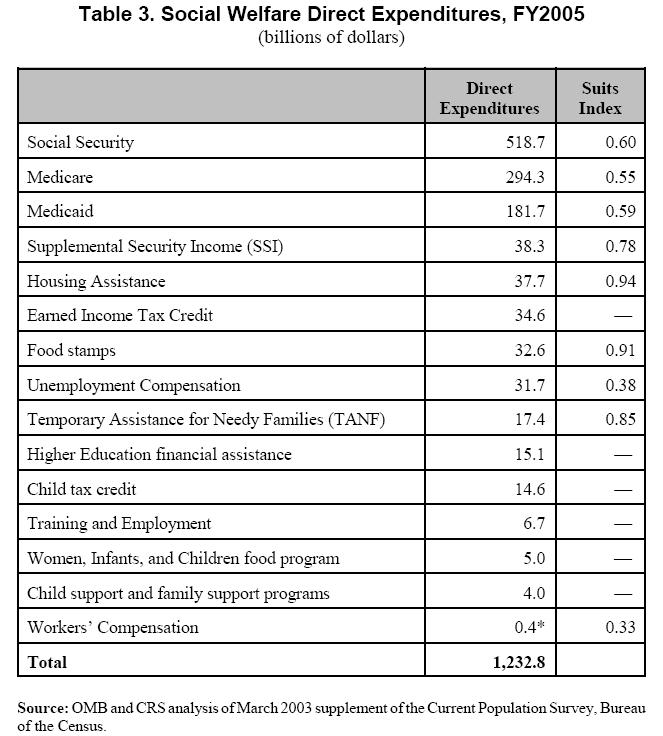 (Click to enlarge.)
Taxes are not an unalloyed good. They have undesireable economic side-effects. However, they are, as Justice Holmes reminded us, the price we pay for civilization. The key is not to oppose all taxes, but to design a tax system that maximizes the benefits to the entire society. Part of that design requires that there be progressivity in the tax system, a requirement that the TF consistently ignores.
Monday, September 25, 2006
Penny Saved, Penny Earned Department
A study from the Employee Benefit Research Institute, Retirement Security in the United States--Current Sources, Future Prospects, and Likely Outcomes of Current Trends, points out that:
The news gets even grimmer when one realizes that Social Security is now scheduled to pay fewer bucks for the bang:
In 1990, the projected 75-year actuarial balance for the Old-Age, Survivors, and Disability Insurance (OASDI) program was –0.91 percent of taxable OASDI payroll, meaning that the OASDI or Social Security tax would need to be increased by 0.91 percentage points to achieve actuarial balance over the next 75 years from 1990. This 75-year deficit grew to more than 2 percent of taxable payroll before improving to just under 2 percent by 2005.In other words, if, in 1990, we had kicked up the FICA tax withheld from employees by less than a half percent and increased the employer share (which, yes, I know, really comes out of the pockets of the employees) by an identical amount, the system would have been guaranteed to be solvent until 2065. Since we've waited 16+ years to take any action (and are likely to wait a good deal longer), the tax needed to assure solvency has more than doubled.
The news gets even grimmer when one realizes that Social Security is now scheduled to pay fewer bucks for the bang:
On top of the projected deficit, the amount of preretirement income a worker can expect at retirement from Social Security at specific ages of commencing benefits is going to decline due to the scheduled increases in the normal retirement age. For those age 65 in 2005 and starting to receiving benefits in that year and having made the equivalent of the average wage index over the course of their working career, the replacement rate of income just prior to turning age 65 from Social Security is 42.2 percent. For those turning age 65 in 2025 with the same earnings, the expected replacement rate is 36.3 percent. The replacement rates from Social Security are lower for higher earners and higher for lower earners.Of course, THAT'S THE GOOD NEWS! The bad news is that:
The Medicare Hospital Insurance Trust Fund is estimated to be facing an actuarial balance of –3.09 percent of taxable payroll, which is a significant increase from the projected balance in 2002 of –2.02 percent. This means that the payroll tax for Medicare would need to be increased by 3.09 percentage points—or benefits would have to be cut by an equivalent amount—in order for the revenues to match expenses for the program over the next 75 years. This level of tax increase would more than double the current payroll tax rate for Medicare.Hat Tip: Docuticker.
The projected growth in these expenditures could present serious issues for the federal and state governments. According to a Congressional Budget Office (CBO) study, depending on the spending path of expenditures for Medicaid and Medicare, these expenditures could amount to from 5.3 percent of gross domestic product (GDP) to 21.9 percent of GDP by 2050. For comparison, Social Security expenditures are projected to account for between 6.3 percent to 6.6 percent of GDP by 2050 under the same sending path assumptions.
The Once and Future Tax
Kelly at Talking Taxes has some interesting observations about the extension of sales taxes to services. She (he?) points out:
Currently, with respect to sales taxes applicable to goods sold to businesses, attempts to make a jurisdictional end-run around the tax are blunted by the application of use taxes. Thus, the business consumer, if it does not pay sales tax, becomes potentially liable to pay a use tax. As a consequence, state tax collectors can usually collect the tax from the seller or the purchaser. (Use taxes are, theoretically at least, also applicable to individual consumer purchases. As a practical matter, however, there is little or no enforcement in this area.)
More importantly, however, the jurisdictional issue throws into question the possible theoretical utility of a national sales tax, the value added tax. One of the allures of value added taxes is that they offer the promise of tamping down domestic consumption, while simultaneously increasing the ability of American businesses to sell abroad. (As in Europe, the VAT would only be applicable to goods that are ultimately sold in the U.S. Thus, it operates as a sort of tariff, with U.S. residents paying more than foreign consumers for goods subject to the VAT.)
Any attempt to impose a VAT-like tax on services turns this policy goal on its head, since service providers in the U.S. would be at a relative disadvantage to foreign service providers when attempting to sell services to U.S. customers. By way of example, neither a VAT nor its state cousin, the sales tax, could be imposed on accounting services provided from Bangalore. The policy hurdles are especially tricky here, since any VAT on services would hobble precisely those sorts of high value services that nations want in order for their economies to remain on the cutting edge.
- Taxes on services can have a "layering" effect, with several layers of tax being added to the cost of goods or services by the time they are acquired by the end consumer.
- Some types of businesses (e.g., newer or smaller companies) could be put at a competitive disadvantage because they have to rely on outsourced service providers, while older and larger companies can rely on in-house (and, thus, sales tax exempt) staff to provide the same services.
- There may be a movement of service providers to states that do not tax their services.
Currently, with respect to sales taxes applicable to goods sold to businesses, attempts to make a jurisdictional end-run around the tax are blunted by the application of use taxes. Thus, the business consumer, if it does not pay sales tax, becomes potentially liable to pay a use tax. As a consequence, state tax collectors can usually collect the tax from the seller or the purchaser. (Use taxes are, theoretically at least, also applicable to individual consumer purchases. As a practical matter, however, there is little or no enforcement in this area.)
More importantly, however, the jurisdictional issue throws into question the possible theoretical utility of a national sales tax, the value added tax. One of the allures of value added taxes is that they offer the promise of tamping down domestic consumption, while simultaneously increasing the ability of American businesses to sell abroad. (As in Europe, the VAT would only be applicable to goods that are ultimately sold in the U.S. Thus, it operates as a sort of tariff, with U.S. residents paying more than foreign consumers for goods subject to the VAT.)
Any attempt to impose a VAT-like tax on services turns this policy goal on its head, since service providers in the U.S. would be at a relative disadvantage to foreign service providers when attempting to sell services to U.S. customers. By way of example, neither a VAT nor its state cousin, the sales tax, could be imposed on accounting services provided from Bangalore. The policy hurdles are especially tricky here, since any VAT on services would hobble precisely those sorts of high value services that nations want in order for their economies to remain on the cutting edge.
Sunday, September 24, 2006
Steal This Election?
Voting in Maryland's recent primary election was a mess. My sense is that the mess was caused primarily by a lack of trained personnel. That is, the problems were not rooted in any deliberate attempt to subvert the election. Rather, the local boards of election did not perform their jobs competently and did not have sufficient competent voting judges at the polling places.
However, there still remains an issue whether electronic voting machines can be intentionally rigged to change the election results. The Center for Information Technology Policy of Princeton University has studied the Diebold AccuVote-TS Voting Machine, the machine used in Maryland. The Center has produced the following video summary:
Needless to say, Diebold has taken issue with the study. The authors of the study have issued a point by point response to Diebold's defense. In another posting, one of the study's authors had this additional comment:
I happen to believe that some form of electronic voting is necessary. However, I also believe that any system of electronic voting must have sufficient redundancy and safeguards built in to assure that elections are not corrupted. I am less than confident that the current Diebold machines are up to the task.
Hat Tip: Robert Ferraro.
However, there still remains an issue whether electronic voting machines can be intentionally rigged to change the election results. The Center for Information Technology Policy of Princeton University has studied the Diebold AccuVote-TS Voting Machine, the machine used in Maryland. The Center has produced the following video summary:
Needless to say, Diebold has taken issue with the study. The authors of the study have issued a point by point response to Diebold's defense. In another posting, one of the study's authors had this additional comment:
[O]ne of the lessons of our study is that even one dishonest election worker can cause big trouble. So the relevant question is not whether the average election worker is honest, but whether a would-be villain can get a job as an election worker.In the 2000 presidential election, because of the so-called "butterfly ballots," 2000 to 2400 of the Buchanan votes were almost surely Gore supporters who mistakenly punched their ballot for Buchanan. Adding these votes to Al Gore's totals would have changed the outcome of the election. Ironically, it was the 2000 debacle that has lead to the accelerated development and use of electronic voting machines.
The answer to that question is almost certainly "yes." Election workers are in short supply in most places, so any competent adult who volunteers is likely to get the job. And every election worker I've talked to has had private access to a voting machine for more than a minute — enough time to inject the kind of vote-stealing software we demonstrated.
As always with computer security, we don't just worry that things will go wrong on their own. What really vexes us is that our adversary is trying to make things go wrong. If a single election worker can corrupt an elections, then the bad guys will become election workers. Without the necessary safeguards, the many honest election workers won't be able to stop them.
I happen to believe that some form of electronic voting is necessary. However, I also believe that any system of electronic voting must have sufficient redundancy and safeguards built in to assure that elections are not corrupted. I am less than confident that the current Diebold machines are up to the task.
Hat Tip: Robert Ferraro.
Monday, September 18, 2006
Contracts, the Rule Against Perpetuities, and Legal Malpractice
An interesting opinion handed down by the Maryland Court of Special Appeals on Friday raises questions concerning the parameters of an attorney's duty of care in drafting a contract.
The case, Cattail Associates, Inc. v. Sass, involved a contract to purchase two undeveloped parcels of real estate that the purchaser intended to develop. The contract specifically provided that closing was to occur after governmental approval of a subdivision of the properties.
Standing alone, the provision with respect to closing constitutes a violation of the Rule Against Perpetuities under Maryland law. That is, because the contract contained no time limit within which subdivision approval must be granted, there was no assurance that the purchaser's interest in the properties "must vest, if at all, not later than twenty-one years after some life in being at the creation of the interest." As a consequence, without more, the contract would not be enforceable.
However, the contract at issue had an addendum that contained a "savings provision." That is, one section of the addendum provided that:
I suppose that all's well that ends well, but I have a further question: Should all sales contracts have Rule Against Perpetuities savings provisions? If so, is it now malpractice in Maryland to draft a contract without such a provision? And, if it's not now malpractice in Maryland to draft a contract without a savings provision, when, if ever, does the requisite standard crystalize sufficiently that, if the savings provision is missing, the attorney's duty of due care has been breached?
This afternoon, right after reading Cattail Associates, I was reviewing a contract for the sale of a restaurant. Closing was to occur within a certain period after approval of the transfer of the liquor license. One of the changes that I suggested be made to the contract was to add a Rule Against Perpetuities savings provision.
The case, Cattail Associates, Inc. v. Sass, involved a contract to purchase two undeveloped parcels of real estate that the purchaser intended to develop. The contract specifically provided that closing was to occur after governmental approval of a subdivision of the properties.
Standing alone, the provision with respect to closing constitutes a violation of the Rule Against Perpetuities under Maryland law. That is, because the contract contained no time limit within which subdivision approval must be granted, there was no assurance that the purchaser's interest in the properties "must vest, if at all, not later than twenty-one years after some life in being at the creation of the interest." As a consequence, without more, the contract would not be enforceable.
However, the contract at issue had an addendum that contained a "savings provision." That is, one section of the addendum provided that:
The parties to this contract intend that it will be binding and legally valid upon them. In order to preclude any application of the Rule Against Perpetuities which would otherwise invalidate and nullify this contract, the parties agree that this contract shall expire, unless otherwise previously terminated, on the last day of the time period legally permitted by the Rule Against Perpetuities in the State of Maryland, in which case all deposits shall be promptly returned to the Buyer.Of course, even this provision was somewhat problematical since it was unclear who the measuring life or lives were intended to be. The Court interpreted the provision broadly, however, and stated that "the clear implication is that the sellers as a class should be considered the measuring lives."
I suppose that all's well that ends well, but I have a further question: Should all sales contracts have Rule Against Perpetuities savings provisions? If so, is it now malpractice in Maryland to draft a contract without such a provision? And, if it's not now malpractice in Maryland to draft a contract without a savings provision, when, if ever, does the requisite standard crystalize sufficiently that, if the savings provision is missing, the attorney's duty of due care has been breached?
This afternoon, right after reading Cattail Associates, I was reviewing a contract for the sale of a restaurant. Closing was to occur within a certain period after approval of the transfer of the liquor license. One of the changes that I suggested be made to the contract was to add a Rule Against Perpetuities savings provision.
Thursday, September 14, 2006
What Have I Wrought?
Beginning in the late 80's, I participated in efforts to promote LLCs. As part of that effort, I chaired the committee that drafted Maryland's LLC Act.
The Maryland LLC Act is among the most opaque in the nation with respect to the identities of the LLC's owners. There is no requirement that there be a public record in this state of the names of either the owners or actual operators of an LLC.
While I continue to favor the general principal of opacity with respect to LLCs, I also favor transparency in campaign contributions and campaign contribution limits. An article in The Annapolis Capital shows that these goals may be at war with each other. According to the article:
Assuming that one is in favor of campaign finance limits, HB 585 makes sense. It is narrowly focused on the issue of campaign finance and does not unnecessarily destroy the default rule of the Maryland LLC Act that LLCs be able to conduct their affairs in private.
Lest there be any confusion, the Maryland LLC Act merely does not mandate automatic public disclosure. There is nothing in the statute that blocks disclosure where there is a compelling reason for disclosure. Thus, discovery in the course of litigation can be used to compel disclosure of an LLC's ownership structure. I believe that limiting campaign contributions provides another compelling reason to mandate disclosure, a goal that can be reached by the limited means suggested in last year's HB 585.
Hat Tip: Unincorporated Business Law Prof.
The Maryland LLC Act is among the most opaque in the nation with respect to the identities of the LLC's owners. There is no requirement that there be a public record in this state of the names of either the owners or actual operators of an LLC.
While I continue to favor the general principal of opacity with respect to LLCs, I also favor transparency in campaign contributions and campaign contribution limits. An article in The Annapolis Capital shows that these goals may be at war with each other. According to the article:
Developers are pouring tens of thousands of dollars into the county executive race by using a loophole in Maryland campaign law that allows them to avoid contribution limits while donating virtually anonymously, an analysis by The Capital shows. In a race that's been dominated by concerns about the scale and pace of growth, voters in Tuesday's primary election will have a hard time figuring out just who's been bankrolling many candidates.The article mentions a bill, HB 585, that was introduced in last year's General Assembly session that passed the House but died in the Senate. The bill, if enacted, would have aggregated campaign contributions by affiliated entities.
The analysis of campaign finance reports filed with the state Board of Elections found at least 84 instances of developers using Limited Liability Companies to give more than $40,000 to county executive candidates.
A legal hybrid between a corporation and a partnership, LLCs are often formed by developers when starting a new project.
It's very hard to track their owners because the state doesn't require LLCs to disclose ownership. And many LLCs have vague names, such as Owings Mills III LLC and Sigma 45 LLC.
LLCs have to be registered with the state. But information on file with the state Department of Assessments and Taxation often contains few clues about LLC owners, instead listing a "resident agent" who may have littleor nothing to do with the ownership.* * * * *
Under state law, political donors can give up to $4,000 to an individual candidate or $10,000 to all candidates or fund-raising entities - political action committees, for example - over a four-year election cycle.
Business accounts and LLCs are subject to the same limits. So business or LLC owners can give up to $10,000 over a four-year election cycle in their own names, plus another $10,000 in their companies' names.
As a result, a developer can give $10,000, then give another $10,000 through his LLC and not have it count against his limit. He can do the same with his second LLC, his third and so on.
Assuming that one is in favor of campaign finance limits, HB 585 makes sense. It is narrowly focused on the issue of campaign finance and does not unnecessarily destroy the default rule of the Maryland LLC Act that LLCs be able to conduct their affairs in private.
Lest there be any confusion, the Maryland LLC Act merely does not mandate automatic public disclosure. There is nothing in the statute that blocks disclosure where there is a compelling reason for disclosure. Thus, discovery in the course of litigation can be used to compel disclosure of an LLC's ownership structure. I believe that limiting campaign contributions provides another compelling reason to mandate disclosure, a goal that can be reached by the limited means suggested in last year's HB 585.
Hat Tip: Unincorporated Business Law Prof.
Wednesday, September 13, 2006
Outsourcing
Linda Beale has a great post explaining why outsourcing of tax collections is bad public policy. She focuses on the practical--outsourcing will, net/net, reduce overall governmental revenues. However, it seems to me that she misses one important point.
The goal of those who favor outsourcing will be advanced by outsourcing--the goal is to reduce governmental revenues. That's why over the last decade the budget for IRS's auditing and collection activities have been systematically reduced.
As I've noted before, the hobbling of IRS's audit and collection functions not only has a direct effect, that is, less audits and less resources devoted to collection lead to less revenue raised, but there's an indirect effect as well. That is, people have additional incentives to play "Audit Roulette," since the likelihood that they will be caught is radically diminished. As a result, taxpayers are less likely to correctly report and pay their tax obligations.
To some extent, of course, the shortfall caused by fewer resourses being devoted to enforcement is offset by increased computerization. As a result, it's simply more difficult to hide income. And, with the growth of the alternative minimum tax, the income tax has at its upper levels essentialy become flat, with fewer significant abilities to decrease one's income tax via aggressive use of deductions.
However, don't be fooled by those attempting to cut the IRS budget and who support outsourcing collections. Their goal is not greater efficiency, but less.
The goal of those who favor outsourcing will be advanced by outsourcing--the goal is to reduce governmental revenues. That's why over the last decade the budget for IRS's auditing and collection activities have been systematically reduced.
As I've noted before, the hobbling of IRS's audit and collection functions not only has a direct effect, that is, less audits and less resources devoted to collection lead to less revenue raised, but there's an indirect effect as well. That is, people have additional incentives to play "Audit Roulette," since the likelihood that they will be caught is radically diminished. As a result, taxpayers are less likely to correctly report and pay their tax obligations.
To some extent, of course, the shortfall caused by fewer resourses being devoted to enforcement is offset by increased computerization. As a result, it's simply more difficult to hide income. And, with the growth of the alternative minimum tax, the income tax has at its upper levels essentialy become flat, with fewer significant abilities to decrease one's income tax via aggressive use of deductions.
However, don't be fooled by those attempting to cut the IRS budget and who support outsourcing collections. Their goal is not greater efficiency, but less.
Monday, September 11, 2006
Don't Tell Linda Tripp About This
Via David Pogue's NYT Blog I learned about free teleconference hosting at LiveOffice (which, as Pogue notes, is not to be confused with Microsoft's Office Live). By merely registering, you can obtain a permanent telephone number that allows you to set up teleconferences for free without having to make any prior reservations. The only catch is that the number is a long distance number and all of the participants have to pay long distance rates to participate. However, since most of us are on plans that provide either large blocks of toll-free time or low rates for long distance calling, this would seem to be a minimal burden.
It was not until I used the service, however, that I learned that it allows the conferences to be recorded for free. However, mindful of the criminal charges brought against Linda ("With Friends Like Her, You Sure As Hell Don't Need Enemies") Tripp, I intend to make certain that I always inform the participants that the conference is being recorded.
It was not until I used the service, however, that I learned that it allows the conferences to be recorded for free. However, mindful of the criminal charges brought against Linda ("With Friends Like Her, You Sure As Hell Don't Need Enemies") Tripp, I intend to make certain that I always inform the participants that the conference is being recorded.
Friday, September 08, 2006
Thursday, September 07, 2006
Cool Running Mon, Nu?
I never cease to be amazed at the wealth of resources on the web. In preparation for the hearings before the Senate Committee on Finance, the staff of the Joint Committee on Taxation released a background paper on Present Law and Background Relating to Executive Compensation.
The hearings were directed toward the supposed cause and effect relationship between the $1 Million cap on executive compensation imposed by IRC Section 162(m) and the stock option backdating scandal. The argument in favor of the repeal of Section 162(m) goes like this: Section 162(m) imposes a penalty tax on executive compensation in excess of $1 Million a year, except compensation that is "performance-based." This has caused a growth in such performance-based compensation mechanisms as stock options which, in turn, have lead to such abuses as backdating of the options.
While I have some doubt as to the wisdom of Section 162(m), the option backdating scandal hardly provides a basis for repeal of the section any more than Bonnie and Clyde provided a justification for outlawing banks. (Although, I suppose that argument would have been a good excuse for a catchy slogan: "Unless banks are outlawed, only outlaws will have banks.")
The report, however, is a gem from a teaching perspective. In 45 concise pages, it presents a useable outline of the various types of deferred compensation arrangements and how they work. I have lectured on the topic, but I had not previously seen such a readable summary.
And the title of this posting? It's derived from the report's discussion of rabbi trusts. Rabbi trusts are deferred compensation arrangements where money or stock is placed in an irrevocable trust rather than being paid to the employee. The compensaton is deferred because (i) the employee cannot draw upon the assets in the trust at will and (ii) the assets in the trust remain subject to the claims of the creditors of the employer in the event of the employer's bankruptcy. (The arrangement got its name because the first letter ruling approving its use was sought by a synagogue for its key employee.)
Even though a rabbi trust has to be subject to the claims of the employer's creditors to allow the compensation to the employee to be deferred, planners have sought to minimize the risk that creditors will actually seize the assets in the trust by organizing the trust under the laws of a foreign jurisdiction. Funds placed in such trusts are now no longer deferred due to the enactment of IRC Section 409A in 2004. However, footnote 33 of the report notes that offshore rabbi trusts have been referred to as a "Rastafarian" rabbi trusts. Somehow, I can't picture Bob Marley wearing tallit.
The hearings were directed toward the supposed cause and effect relationship between the $1 Million cap on executive compensation imposed by IRC Section 162(m) and the stock option backdating scandal. The argument in favor of the repeal of Section 162(m) goes like this: Section 162(m) imposes a penalty tax on executive compensation in excess of $1 Million a year, except compensation that is "performance-based." This has caused a growth in such performance-based compensation mechanisms as stock options which, in turn, have lead to such abuses as backdating of the options.
While I have some doubt as to the wisdom of Section 162(m), the option backdating scandal hardly provides a basis for repeal of the section any more than Bonnie and Clyde provided a justification for outlawing banks. (Although, I suppose that argument would have been a good excuse for a catchy slogan: "Unless banks are outlawed, only outlaws will have banks.")
The report, however, is a gem from a teaching perspective. In 45 concise pages, it presents a useable outline of the various types of deferred compensation arrangements and how they work. I have lectured on the topic, but I had not previously seen such a readable summary.
And the title of this posting? It's derived from the report's discussion of rabbi trusts. Rabbi trusts are deferred compensation arrangements where money or stock is placed in an irrevocable trust rather than being paid to the employee. The compensaton is deferred because (i) the employee cannot draw upon the assets in the trust at will and (ii) the assets in the trust remain subject to the claims of the creditors of the employer in the event of the employer's bankruptcy. (The arrangement got its name because the first letter ruling approving its use was sought by a synagogue for its key employee.)
Even though a rabbi trust has to be subject to the claims of the employer's creditors to allow the compensation to the employee to be deferred, planners have sought to minimize the risk that creditors will actually seize the assets in the trust by organizing the trust under the laws of a foreign jurisdiction. Funds placed in such trusts are now no longer deferred due to the enactment of IRC Section 409A in 2004. However, footnote 33 of the report notes that offshore rabbi trusts have been referred to as a "Rastafarian" rabbi trusts. Somehow, I can't picture Bob Marley wearing tallit.
Sunday, September 03, 2006
How Knaves Fool Fools
The weekend WSJ has an editorial, Incomes and Politics: Comparing the Current Decade to the Sainted 1990s, that, when read closely, demonstrates one method used by knaves to fool fools.
The overarching thesis of the editorial is that, thanks to massive tax cuts, we're doing fine, thank you. The editorial goes so far as to contend that the tax cuts have actually made the tax code more progressive:
Apparently, the WSJ doesn't know what a progressive tax code is. Let me explain: It's a tax code that, when all taxes are factored in, is progressive. That is, the more one makes in income, the larger percentage of that income is paid in taxes. The key phrase is "when all taxes are factored in." Look carefully at the WSJ quote above. It focuses solely on income taxes.
Back in April, I had a post, Fools and Knaves, Wall Street Journal Edition. Since the WJS is pushing the same baloney now that it was peddling then, let me offer the quote contained in my previous posting from a study, authored by Michael Strudler and Tom Petska of the IRS and Ryan Petska of Ernst and Young:
Hat Tip: TaxProf.
An Additional Comment:
The WSJ editorial has the following chart, which TaxProf reproduces:

Note the title of the table on the bottom: "Percentage share of federal taxes and total income, 2004." (Emphasis added.)
Wrong, wrong, wrong.
To the extent that I understand the editorial, based upon a report that's not yet publicly available, the chart shows the distributional burden only of income taxes, not all federal taxes. In other words, the knaves have now even fooled themselves into believing their baloney.
The overarching thesis of the editorial is that, thanks to massive tax cuts, we're doing fine, thank you. The editorial goes so far as to contend that the tax cuts have actually made the tax code more progressive:
[T]he new data show that the bottom 50% of Americans in income--U.S. households with an income below the median of $44,389--paid a smaller share of total income taxes in 2004 (3.3%) than in Bill Clinton's last year in office (3.9%). That 3.3% is the lowest share of total income taxes paid by the bottom half of earners in at least 30 years, and probably ever. The majority of American families with an income below $40,000 pay no income tax at all today, and many of them also get a welfare subsidy from the Earned Income Tax Credit that effectively offsets much of what they pay in payroll taxes.Emphasis added.
By contrast, Americans with an income in the top 1% paid 36.9% of all federal income taxes in 2004, down slightly from 37.4% at what was the height of the dot-com boom in 2000. But the top 5% and 10% of earners saw an increase in their tax share over that same period, with the top 5%'s share rising to 57.1% in 2004 from 56.5% in 2000. If this isn't the definition of a highly "progressive," a k a redistributionist, tax code, we don't know what is.
Apparently, the WSJ doesn't know what a progressive tax code is. Let me explain: It's a tax code that, when all taxes are factored in, is progressive. That is, the more one makes in income, the larger percentage of that income is paid in taxes. The key phrase is "when all taxes are factored in." Look carefully at the WSJ quote above. It focuses solely on income taxes.
Back in April, I had a post, Fools and Knaves, Wall Street Journal Edition. Since the WJS is pushing the same baloney now that it was peddling then, let me offer the quote contained in my previous posting from a study, authored by Michael Strudler and Tom Petska of the IRS and Ryan Petska of Ernst and Young:
[S]ince 1997, with continuation of the 39.6-percent rate but with a lowering of the maximum tax rate on capital gains, the redistributive effect again declined. It appears that the new tax laws will continue this trend. Analysis of panel data shows that these trends are not quite as great as seen by looking at annual cross-section data, but the trends cited above are still apparent.The WSJ editorial is based upon an IRS report that has not yet been released, but which the WSJ has had an "early look at." I will update and offer additional comments when the report becomes publicly available.
Hat Tip: TaxProf.
An Additional Comment:
The WSJ editorial has the following chart, which TaxProf reproduces:

Note the title of the table on the bottom: "Percentage share of federal taxes and total income, 2004." (Emphasis added.)
Wrong, wrong, wrong.
To the extent that I understand the editorial, based upon a report that's not yet publicly available, the chart shows the distributional burden only of income taxes, not all federal taxes. In other words, the knaves have now even fooled themselves into believing their baloney.
Monday, August 28, 2006
Freeloaders
Two recent opinions illustrate the problems that America's mobility poses states and localities in raising tax revenue.
In Antzis v. Comptroller, the Maryland Tax Court addressed the question of whether a tax, levied on the Maryland income of non-Maryland residents, was constitutional. The facts, as set forth by the Court, are as follows:
In one paragraph, the Tax Court succinctly put that argument to bed:
In other words, there's no free lunch when it comes to municipal services.
In District of Columbia v. Bender, the precise legal issue was different, but the overriding tax policy issue was the same. There, owners of valuable commercial real estate in the District of Columbia sought to avoid paying taxes on income generated by those properties. The specific question before the Court was whether the tax statute violated the Home Rule Act, but the same basic principle was at stake: Whether income that is generated as a direct consequence of municipal services can be tax to fund those services. Here too, the Court sustained the taxing authority.
There was a time when most commercial activity could be readily identified to a particular physical situs. To a growing degree, that is no longer the case. Capital, both human and economic, can be put to work in one locale but managed a substantial distance away. The underlying tax policy question is whether the governmental authorities who create and maintain the public infrastructure that supports the economic activities in a specific locale can be funded by taxing income that will, if not immediately taxed, be "exported" out of the locality.
In Antzis v. Comptroller, the Maryland Tax Court addressed the question of whether a tax, levied on the Maryland income of non-Maryland residents, was constitutional. The facts, as set forth by the Court, are as follows:
Petitioners are three married couples that reside in Pennsylvania and file joint nonresident Maryland income tax returns. The returns are filed because in each case the husband is a partner in a multi-state law firm with Maryland and Pennsylvania operations. The partnership apportions its income among the states in which it does business, and this creates Maryland taxable income for each Petitioner pursuant to §10-210 [of the Maryland Tax-General Article]. There also exists a withholding obligation for the partnership under §10-102.1 [of the Maryland Tax-General Article]. These taxes are not in dispute.The taxpayers principally relied upon Fulton Corp. v. Faulkner, 516 U.S. 325 (1996), contending that the Maryland statute expressly discriminates against nonresidents by levying a tax on nonresident income which has no direct corollary with respect to residents. Among the arguments that they raised was that "the special tax compensates for nothing, and cannot be 'fairly related to the services provided by the State [which benefit interstate commerce].'"
In 2004, the General Assembly of Maryland enacted a special tax applicable to non-residents. The tax requires non-residents to pay income tax equal to the state rate (4.75%) imposed by §10-105 [of the Maryland Tax-General Article], "plus an amount equal to the lowest county income tax rate set by any Maryland county in accordance with §10-106.1 of [of the Maryland Tax-General Article]." . . . Petitioners did not pay the amount required by §10-106.1 and were assessed accordingly. Petitioners' contention is that the tax imposed by §10-106.1 is unconstitutional.
Maryland income taxes on both residents and non-residents can be described as follows. The resident taxpayers’ payment is split between two separate taxes, namely the state income tax portion that goes into the General Fund of Maryland, and a local tax portion that goes to the taxpayer’s county of residence, or to Baltimore City in the case of a city resident. The local tax revenues are used to fund local services. By contrast, the non-resident taxpayers' tax consists of the state income tax portion at the same rate paid by residents, plus the special non-resident tax, both of which go into the General Fund. Non-residents pay no local income tax because they have no local county of residence. As stated earlier, residents do not pay the special non-resident tax prescribed by §10-106.1.
Petitioners contend that imposing the special non-resident tax exclusively on nonresidents, coupled with the differences in how the tax revenue is allocated, equates to discrimination against the non-resident in violation of both the United States Constitution and the Maryland Constitution and Declaration of Rights. To support these contentions, the Petitioners assert that the state income tax and the local income tax are different taxes and cannot be combined to determine whether residents and non-residents are being taxed equally.
In one paragraph, the Tax Court succinctly put that argument to bed:
To fully explore these contrasting points-of-view, this Court questioned counsel as to whether a nonresident taxpayer gains any direct or indirect benefit from local services being provided by a Maryland county or by Baltimore City. Such local services traditionally include police and fire protection, waste disposal, water and sewer services, and the myriad of other local governmental activities on behalf of people within each local jurisdiction. It was conceded that such local benefits do, in fact, accrue both directly and indirectly to nonresidents while they are present or doing business in a jurisdiction. Obviously, both residents and nonresident receive these local governmental benefits by mere virtue of their physical presence within a jurisdiction, either in person or as part of a business entity doing business within the jurisdiction. It seems perfectly reasonable, therefore, for the State to seek compensation for these services from non-residents through the tax system. Although there is no direct mechanism to allocate the special non-resident tax revenue to a particular county, the General Fund of Maryland exists to provide funding for the benefit of all Maryland counties and Baltimore City, selectively, indirectly, to all persons or entities physically situate or doing business within its local borders.Emphasis added.
In other words, there's no free lunch when it comes to municipal services.
In District of Columbia v. Bender, the precise legal issue was different, but the overriding tax policy issue was the same. There, owners of valuable commercial real estate in the District of Columbia sought to avoid paying taxes on income generated by those properties. The specific question before the Court was whether the tax statute violated the Home Rule Act, but the same basic principle was at stake: Whether income that is generated as a direct consequence of municipal services can be tax to fund those services. Here too, the Court sustained the taxing authority.
There was a time when most commercial activity could be readily identified to a particular physical situs. To a growing degree, that is no longer the case. Capital, both human and economic, can be put to work in one locale but managed a substantial distance away. The underlying tax policy question is whether the governmental authorities who create and maintain the public infrastructure that supports the economic activities in a specific locale can be funded by taxing income that will, if not immediately taxed, be "exported" out of the locality.
Sunday, August 27, 2006
Ain't Necessarily So
Estate-Tax Plans Get Trickier in the weekend WSJ suggests that estate planning has become immeasurably complex because, as currently drafted, the estate tax is scheduled to disappear in 2010 and then bounce back again, at higher rates, in 2011. The article focuses on the problems inherent in measuring how much life insurance estates, particularly modest estates, will need as part of an estate plan.
The article is needlessly alarmist.
No one, least of all me, has a perfect crystal ball when it comes to predicting what Congress will do. But it's virtually a slam-dunk, sure bet that the scheduled reversion of the estate tax to the 55% rates and $1M lifetime credit of 1997 will never take place. It is only a shade less likely that the lifetime credit will, after its increase to $3.5 million, be reduced. Thus, the only real uncertainties are:
The current estate tax law provides a huge subsidy to the life insurance industry. Virtually any change in the law will dramatically reduce the market for such insurance. Hmmm.
Of the 16 paragraphs in the article, 14 discuss the use of life insurance in estate planning that has, as its principal goal, tax minimization. Could it be that the article was nothing more than the fruit of efforts by insurance industry flacks attempting to sow panic among the wealthy in order to get in a few last licks?
Nahhh.
Hat Tip: TaxProf
The article is needlessly alarmist.
No one, least of all me, has a perfect crystal ball when it comes to predicting what Congress will do. But it's virtually a slam-dunk, sure bet that the scheduled reversion of the estate tax to the 55% rates and $1M lifetime credit of 1997 will never take place. It is only a shade less likely that the lifetime credit will, after its increase to $3.5 million, be reduced. Thus, the only real uncertainties are:
- Can any compromise be enacted early enough to avoid the zero estate tax in 2010? Let me suggest that this issue causes only a limited degree of planning uncertainty, since few clients are focusing their planning efforts around the fact that 2010 will be their year of demise. If no compromise is enacted by 2010 and your client dies in that year, it only means that his or her heirs hit the Estate Tax Lottery Jackpot. If that is the case, it is unlikely that any tax practitioner will have to answer to an unhappy client for failing to correctly predict the state of the law three and a half years in the future.
- Will the estate tax rates be higher than they are currently? At best, this is a minimal factor in the estate tax planning for most clients, since any increase in rates is likely to be more than offset by a hefty increase in the lifetime credit and by other, new, planning devices built into any compromise.
- How high will the lifetime credit go? Again, this would seem to create only a limited degree of planning uncertainty for most clients. After all, if we assume that the $3.5 million credit is, as a practical matter, a floor for any compromise, then the only families exposed to any estate tax after a compromise is reached are those with family wealth well in excess of $7 million. My suspicion is that relatively few readers of even the WSJ fall into this category.
The current estate tax law provides a huge subsidy to the life insurance industry. Virtually any change in the law will dramatically reduce the market for such insurance. Hmmm.
Of the 16 paragraphs in the article, 14 discuss the use of life insurance in estate planning that has, as its principal goal, tax minimization. Could it be that the article was nothing more than the fruit of efforts by insurance industry flacks attempting to sow panic among the wealthy in order to get in a few last licks?
Nahhh.
Hat Tip: TaxProf
Wednesday, August 23, 2006
Murphy's Law?
Much of what passes for conservative political thought these days is nothing more than rationalizations attempting to justify policies that favor the rich and economically entrenched. It is therefore refreshing to find a judicial opinion that actually applies conservative principles.
Yesterday, in the case of Murphy v. IRS, the U.S. District Court for the District of Columbia (per Ginsburg, C.J.) determined that, as a matter of Constitutional law, "compensation for a non-physical personal injury is not income under the Sixteenth Amendment if . . . it is unrelated to lost wages or earnings."
The taxpayer had "filed a complaint with the Department of Labor alleging that her former employer . . . in violation of various whistle-blower statues, had 'blacklisted' her and provided unfavorable references to potential employers after she had complained to state authorities of environmental hazards . . . ." The Secretary of Labor found in favor of the taxpayer and the case was remanded to an administrative law judge for a determination of the amount of compensatory damages to which she was entitled.
The taxpayer:
In its analysis, the Court extensively reviewed the history of the Sixteenth Amendment. Ultimately, it agreed with the taxpayer's contention that:
The decision in Murphy re-establishes balance to the equation, at least in those situations where the award sought is for "personal injury." (This would not include, however, awards for economic injuries such as lost wages, etc. In my previous comments on Banks, I pointed out some of the practical problems that employees face in attempting to use attorneys or other paid agents in negotiating contracts or other compensation awards.)
Murphy is a conservative opinion in the traditional sense of the word "conservative." It is doubtful whether a "conservative court" in the post-20th Century meaning of the term (the Fourth Circuit, for instance) would have reached the same conclusion as did the D.C. Circuit.
Yesterday, in the case of Murphy v. IRS, the U.S. District Court for the District of Columbia (per Ginsburg, C.J.) determined that, as a matter of Constitutional law, "compensation for a non-physical personal injury is not income under the Sixteenth Amendment if . . . it is unrelated to lost wages or earnings."
The taxpayer had "filed a complaint with the Department of Labor alleging that her former employer . . . in violation of various whistle-blower statues, had 'blacklisted' her and provided unfavorable references to potential employers after she had complained to state authorities of environmental hazards . . . ." The Secretary of Labor found in favor of the taxpayer and the case was remanded to an administrative law judge for a determination of the amount of compensatory damages to which she was entitled.
The taxpayer:
submitted evidence that she had suffered both mental and physical injuries as a result of the . . . .blacklisting . . . . A physician testified [that the taxpayer] had sustained "somatic" and "emotional" injuries. One such injury was "bruxism," or teeth grinding often associated with stress, which may cause permanent tooth damage. Upon finding [that the taxpayer] had also suffered from other "physical manifestations of stress" including "anxiety attacks, shortness of breath, and dizziness," the ALJ recommended compensatory damages totaling $70,000, of which $45,000 was for "emotional distress or mental anguish," and $25,000 was for "injury to professional reputation" from having been blacklisted. None of the award was for lost wages or diminished earning capacity.IRC Section 104(a) provides that "gross income [under IRC Section 61] does not include the amount of any damages (other than punitive damages) received ... on account of personal physical injuries or physical sickness." Since 1996 it has further provided that, for purposes of this exclusion, "emotional distress shall not be treated as a physical injury or physical sickness." The taxpayer had contended that the award was not taxable because she had suffered physical injury (e.g., the bruxism). However, that argument was rejected by the Court which stated that:
[The taxpayer] no doubt suffered from certain physical manifestations of emotional distress, but the record clearly indicates [that she was] awarded . . . compensation only "for mental pain and anguish" and "for injury to professional reputation."The Court then turned to the argument that makes this case remarkable. Specifically, is IRC Section 104(a)(2), which does not permit the award to be excluded from income, constitutional? The Court held that it was not.
In its analysis, the Court extensively reviewed the history of the Sixteenth Amendment. Ultimately, it agreed with the taxpayer's contention that:
a damage award for personal injuries-- including nonphysical injuries -- is not income but simply a return of capital -- "human capital," as it were. See Gary S. Becker, Human Capital (1st ed. 1964); Gary S. Becker, "The Economic Way of Looking at Life," 43-45 (Nobel Lecture, Dec. 9, 1992).In a footnote, the Court remarked:
[The taxpayer's point] is that as with compensation for a harm to one's financial or physical capital, the payment of compensation for the diminution of a personal attribute, such as reputation, is but a restoration of the status quo ante, analogous to a "restoration of capital," [Commissioner v.] Glenshaw Glass, 348 U.S. [426 (1955)] at 432 n.8; in neither context does the payment result in a "gain" or "accession[] to wealth," id. at 430-31.In Commissioner v. Banks, the Supreme Court determined that when a litigant's recovery constitutes income, the litigant's income includes the portion of the recovery paid to the attorney as a contingent fee. As a practical matter, any legal fee paid in the course of a lawsuit except one for personal injury will, under IRC Section 104, generally get added back into income when computing the claimant's liability for alternative minimum tax. Since such fees are not deductible for alternative minimum tax purposes, they are, in essence, not deductible at all. See my comments here made before Banks was handed down.
The decision in Murphy re-establishes balance to the equation, at least in those situations where the award sought is for "personal injury." (This would not include, however, awards for economic injuries such as lost wages, etc. In my previous comments on Banks, I pointed out some of the practical problems that employees face in attempting to use attorneys or other paid agents in negotiating contracts or other compensation awards.)
Murphy is a conservative opinion in the traditional sense of the word "conservative." It is doubtful whether a "conservative court" in the post-20th Century meaning of the term (the Fourth Circuit, for instance) would have reached the same conclusion as did the D.C. Circuit.
Monday, August 21, 2006
Income and Wealth Inequality
Brad DeLong has a good summary of the various positions in the debate over whether the growing inequality of income and wealth is determined by governmental policies, including tax policies, or whether it is primarily an outgrowth of other factors such as technology and the globalization of labor markets. It's fairly lengthy as blog postings go, but well worth reading since DeLong is relatively even-handed in describing the various opposing points of view.
Friday, August 18, 2006
And This Is Bad Because . . . ?
In his NYT column today, Wages, Wealth and Politics, (both the column and the follow-up on his related weblog are behind the Times Select subscription wall), Paul Krugman discussed the rapidly growing gap in income and wealth between the really wealthy and the rest of us, drawing a causal connection between our politics and our economy:
I suspect that there's a good deal wrong with employee management in the federal government. But to say that the principal problem is that federal employees are making too much money relative to employees in the private sector is crazy. After all, one of the major social problems we face is that private sector employees are taking it on the chops. Which is to say that the principal problem we face is that private sector employees are not making enough. The solution to that problem is not to institute policies with respect to federal employees similar to those that have undermined the economic well-being of private sector employees.
Full Disclosure: The woman with whom I sleep with is a federal employee.
[S]ince 1980 the U.S. political scene has been dominated by a conservative movement firmly committed to the view that what’s good for the rich is good for America. Sure enough, the rich have seen their incomes soar, while working Americans have seen few if any gains.In the blog that he maintains in conjunction with his column, Krugman expanded on that theme:
There are real questions about just how closely supply and demand determine wages; the labor market isn't just like the market for wheat. Also, there's a lot of evidence that unions have a large effect on the wages of non-union workers, too. When you're in an economy in which about a third of private-sector workers are unionized, as was true of the United States when I was growing up, even non-union employers tread carefully, for fear of giving their workers a strong incentive to organize. When you're in an economy where unions have been largely banished from the private sector, as is the case now, things are very different.Of course, there are bright spots. Government workers, who, by dint of being voters, have some drag with their paymasters, have seen their incomes rise over time. Rather than embracing this as good news, in an op-ed piece in WaPo last Sunday, Chris Edwards, tax director at the Cato Institute, was critical of the growth in federal wages:
The Bureau of Economic Analysis released data this month showing that the average compensation for the 1.8 million federal civilian workers in 2005 was $106,579 -- exactly twice the average compensation paid in the U.S. private sector: $53,289. If you consider wages without benefits, the average federal civilian worker earned $71,114, 62 percent more than the average private-sector worker, who made $43,917.
* * * * *
To get spending under control, Congress should consider trimming overly generous benefit packages and freezing federal wages for a few years.His comments were echoed by the Tax Foundation's Andrew Chamberlain.
I suspect that there's a good deal wrong with employee management in the federal government. But to say that the principal problem is that federal employees are making too much money relative to employees in the private sector is crazy. After all, one of the major social problems we face is that private sector employees are taking it on the chops. Which is to say that the principal problem we face is that private sector employees are not making enough. The solution to that problem is not to institute policies with respect to federal employees similar to those that have undermined the economic well-being of private sector employees.
Full Disclosure: The woman with whom I sleep with is a federal employee.
Subscribe to:
Posts (Atom)